
Here’s my favorite variation on my favorite bread--the Basic Country Bread from Tartine Bread. Since it’s now my most frequent bake, I figured I should write up my procedure both for my own reference and the breadblogosphere.
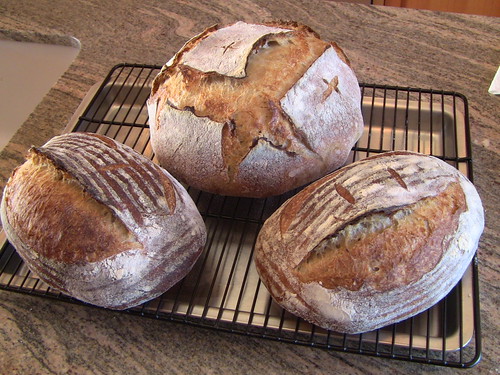
This version has 50% more whole wheat flour in the final dough than the book’s formula. I make only as much levain as is needed for the bake, not double the needed amount as the formula calls for. I divide the dough in two mid-way through the bulk ferment, bake two 485-490 gram boules or batards on a baking stone the first day and, having retarded the second half overnight, I bake a one kilo boule in my Dutch Oven the next day.
Ingredients:
700 grams plus 50 grams water
200 grams levain (see below)
850 grams white flour
150 grams whole wheat flour
20 grams salt
Directions:
Make the Levain:
The night before the dough is mixed, take 1 heaping tablespoon of a mature starter (I used my usual 75% hydration mixed-grain starter) and feed it with 100 grams of warm (75-80 degree F) water and 100 grams of a blend of 50% AP flour/50% whole wheat bread flour. I use Central Milling Organic Artisan Baker’s Craft white flour (enriched with malted barley) and Central Milling Organic Hi-Protein Fine whole wheat flour.

Cover tightly and let the levain rise overnight at room temperature.

The next morning, the levain should be airy and light. To find out if it’s ready, put a small piece in room temperature water to see if it floats. If it sinks, it is not ready to use and needs more time to ripen.
Mix the Dough:
Pour 700 grams of 80 degree F water into a large mixing bowl. Add 200 grams of the levain and stir it to disperse.

Mix the flours – 850 grams white and 150 grams whole wheat – together and add the flours to the mixing bowl. Then mix thoroughly by hand to hydrate all of the flour.
Cover the bowl with a damp dishtowel or plastic wrap and let the dough rest (autolyse) for 30-40 minutes.
After the dough has rested, add the 20 grams of salt and the 50 grams warm water. Incorporate the salt and water into the dough by squishing the dough between your fingers until thoroughly mixed.
Bulk Fermentation
The dough should bulk ferment for 3 to 4 hours at room temperature in a bowl covered with a damp dishtowel or plastic wrap.
During the first two hours of fermentation, give the dough one series of four stretch-and-folds every half hour or so. During the last hour or so, stretch and fold the dough gently every 45 minutes or so.
If the dough seems to be developing slowly, extend the bulk fermentation time. When properly fermented the dough should be puffy and gas bubbles should be visible on the surface.
Retarded Fermentation (Optional)
I can’t fit two one-kilo boules on my baking stone at once, so I usually divide the dough in half after the first 90 minutes of bulk fermentation. I round up half the dough, place it in a lightly oiled bowl with a tight cover, and refrigerate overnight or up to a full day. The other half continues with the bulk fermentation at room temperature.
Take the refrigerated dough out of the refrigerator about five hours before you plan to bake. Let it warm in the bowl for two or three hours, with stretch-and folds at the 60 minute and 120 minute points.
Shaping the Loaves and Proofing
This dough is extensible and sticky, so it takes careful handling and just the right amount of flour to shape the loaves. The Tartine Bread formula calls for loaves of just under one kilo (two loaves from the dough recipe). I usually make three loaves from a recipe, two scaled at about 485-490 grams and one at about one kilo. I find that the flavor and texture are just as good as with the bigger loaves.
When the dough is fully fermented, scrape it onto a lightly floured board with the smoother side of the dough (what had been on the bottom of the bowl) downward. Be careful not to get a lot of flour on the side of the dough that will form the seam of the loaf. With lightly floured hands and quick movements, pre-shape a ball by stretching the dough gently from the sides, up to meet in the middle, and seal the seam by pinching. Rest the dough balls for 20-30 minutes, covered with a slightly damp dishtowel.
With lightly floured hands, form the dough balls into boules, by again stretching the sides up toward the center and pinching the seam. Then, on an unfloured part of your board or counter (but with well-floured hands), place the seam side down and tighten the boule surface using the method dmsnyder made famous (http://weightloss-slim.fit/keyword/boule-shaping%3C/a%3E%29.%3C/p%3E%3Cp%3EPlace the boule in a well-floured banneton with seams upward, covered with a damp dishtowel or place in a plastic bag.
You can also form the dough into a batard shape instead of a boule.
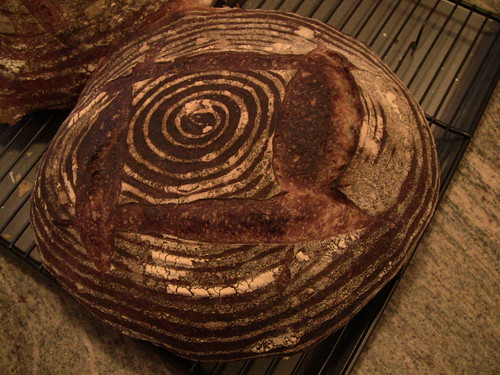 Full-size Loaf Baked on Stone
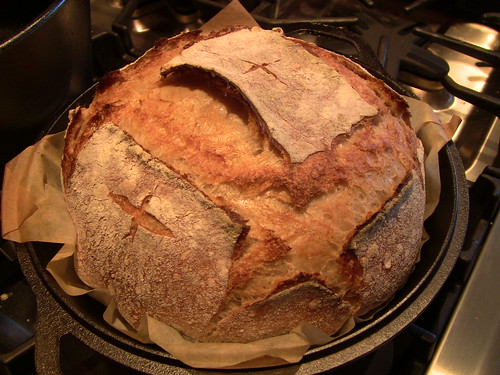 Full-size Loaf in Dutch Oven
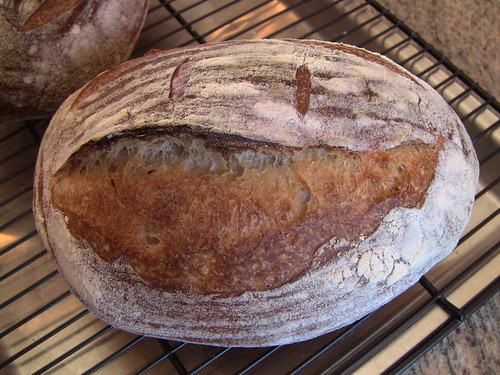 Very Happy Batard
 Two Mini-boules
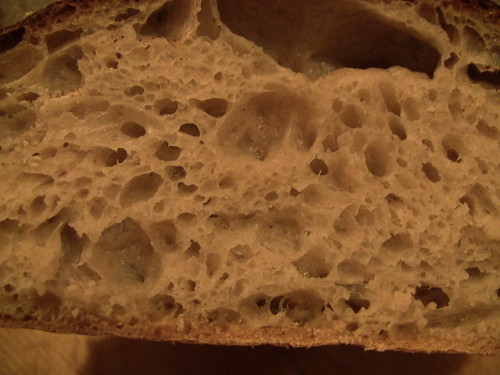 Crumb Shot
Notes on Variations
Three of my variations from the Tartine Bread directions are just for convenience—making only the amount of levain needed, retarding part of the dough and baking smaller loaves. None of these variations seem to impair the quality of the bread. Both the taste and texture are—in my experience--every bit as good as the bread produced by following the directions precisely. I should say, though, that retarding and then re-warming the dough should be tried only after you have baked according to the book’s directions a few times, so you know what to look for in judging the proper degree of fermentation. Also, proofing smaller loaves will take a bit less time than full-size loaves.
My last variation is for flavor. Going from 100 grams of whole wheat in the final dough to 150 grams makes a slight difference, but a pleasant one if you like a bit more of that nutty taste for added complexity. Some time, I plan to try adding a couple of tablespoons of toasted wheat germ to the dough.
By the way, I was watching a video with Chad Robertson promoting his book, and I noticed that on his work table was an open bag of the very same Central Milling flour that I use. No wonder his bread is so good.
Besides its wonderful, subtle but complex, flavor, the distinguishing feature of this bread is its moist crumb texture—hitting the sweet spot between chewy and soft. I bet it would make great tartines!
Enjoy.
Glenn
- GSnyde's Blog
- Log in or register to post comments
The grigne grin is pretty cute. He looks like a happy son of a miche.
David
Now that's a pun, David - the first I've come across for quite a while that didn't elicit the automatic groan that is traditional with punning. Not until after the chuckle, anyway!
Lovely breads, Glenn!
Cheers!
Ross
I'd been meaning to write up my procedure for some time. The BCB formula in the book is somewhat daunting, and it's really not that hard.
As to the grinning batard, I'm not sure "son" is the right term for the result of dough division: maybe I'd call it a demi-blob. Or a cleavage.
Glenn
Beautiful loaves Glenn! Those are what I hope my country loaves will look like one day!
Dvuong, if you have a good strong levain and give due attention to the fermentation process and the shaping, this bread is very rewarding. Thanks for your comment.
Glenn
Nice Glenn.
It looks like you increased the whole grain percentage by kept the hydration the same, is this correct?
I didn't increase the hydration to account for the added whole wheat. I would have thought that this variation would have been a bit easier to handle with the more absorbent flour mix, but it felt about the same (really sticky).
Thanks for the comment, Arlo.
Glenn
That sounds like a nice variation, Glenn! And cute loaves! Well done!
Thanks for sharing!
Jay
Glenn
Lovely looking bread, Glenn. And very thorough write up, too. I don't have the patience for such a detailed write up. That Dutch Oven boule got some really good oven spring. Nice baking. :)
Syd
Thanks, Syd. The cast iron Dutch oven version had the best spring, but I prefer the darker, crispier crust produced by baking on a stone.
Glenn
Nicely written up. It's plain to see, by the gringe on the loaves, that some real love went into their baking!
Sylvia
Sylvia-- Yes, love is an essential ingredient. But don't minimize the importance of steamy towels.
Thanks.
Glenn
Those are beautiful, Glenn.
I must admit that the advantage of having baked this bread several times is that I could choose the best from a number of photos. Not that any of my BCB bakes have been disasters.
Glenn
Glenn,
I really enjoyed reading your post.
I've been baking tartine bread for a while now and it's a favorite in our house.
I just need to try your way of creating steam in the oven so I get a crispier crust. My crust is nice and hard when I take the bread out of the oven but after it cools down it becomes soft. Maybe your method will improve it.
Where do you buy the flour? I also noticed the brand in his video, but haven't been able to find it in any store. Costco has Organic APF but I use only bread and WWF for bread baking.
I also live in SF area.
PB--
If you use the TFL search bar and enter "Central Milling", you'll find lots of info. Here's an example: http://weightloss-slim.fit/node/21720/availability-central-milling-co-flour%3C/a%3E.%3C/p%3E%3Cp%3EThis type of bread really doesn't keep a crispy crust for long. The crumb is so moist that the crust goes chewy pretty fast. It is great sliced and toasted, though.
Glenn
honestly, you went from zero to pro in a blink! When are you & David going to offer baking retreats in Ft. Bragg? hint, hint
Toni
I've been at it about 10 months now. I've probably baked 40 batches of bread/baguettes/rolls. I still mess up sometimes, but there are more good bakes and the good bakes are getting better. Nowhere near "pro", though.
David could give good baking classes, I bet.
Glenn
Use my 100% hydration starter for this?
Just adjust the final flour - or accept that it will be a bit different in hydration. No problem. It should make fine loaves either way!
Good Luck!
Jay
You can...and should.
Glenn
the only changes I made were using 100% hydration starter and I used 800 g white all purpose and 200 whole wheat bread flour. I would love to add some toasted seeds to this bread...would I need to do anything to compensate hydration-wise?
Depends on what seeds but in general just soak them overnight. You could always just wing it and make a batch with no adjustment. As wet as the Tartine is it will work. Then you can adjust hydration up to compensate. Too many factors to generalize. Some seeds/nuts don't need adjustment and others do, and it depends on how much you add. I think winging a batch and then adjusting is probably the easiest and most foolproof approach.
Good Luck!
Jay
Jay for your reply! I will report results next batch. I love the sunflower seed/pumpkin seed combo!
I make a version of Eric Kayser's Pain aux Cereales which uses LOTS of seeds and is a really wet, sticky dough. Using seeds to coat the surface does a lot to dry the surface a bit and creates a barrier to sticking that is a plus on wet doughs! Not a bad idea for a "seedy" Tartine!
Looking forward to a report!
Jay