
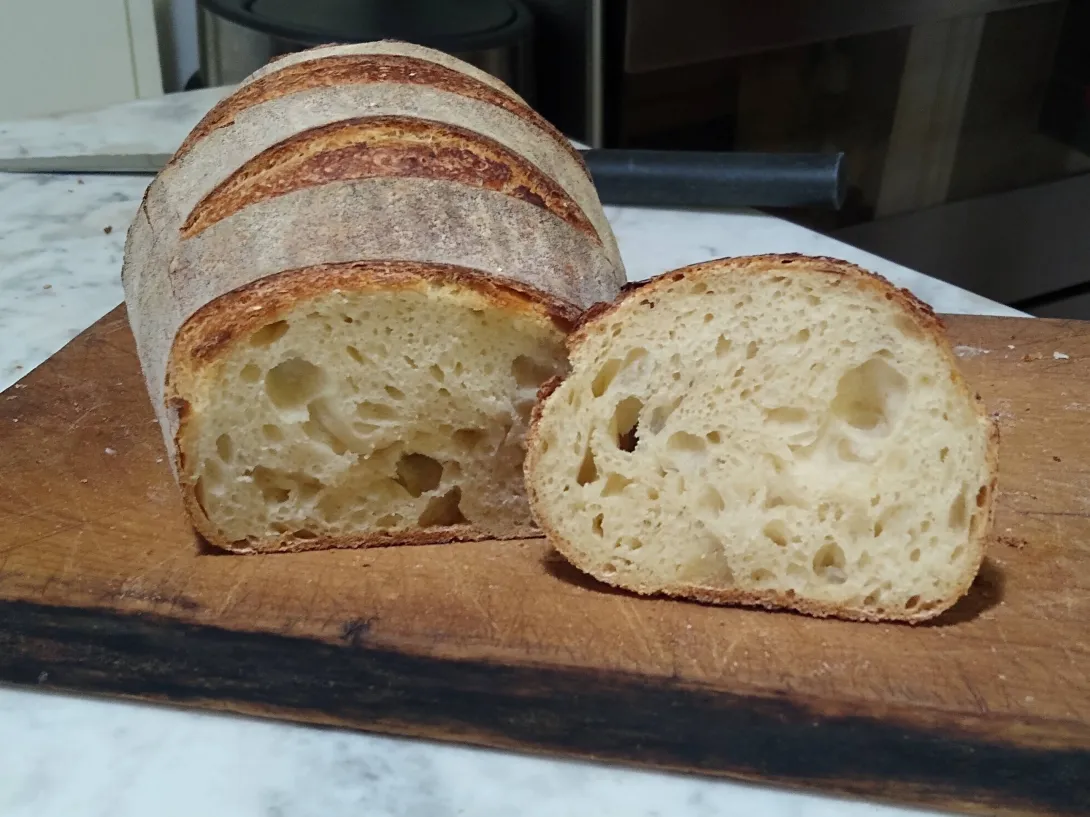
Decided to try-out the techniques I read and heard about from the locals when visiting Matera over the Christmas holidays to make an almost 100% semola rimacinata durum wheat loaf.
Didn't try the characteristic shaping. Thought it better to take on one challenge at a time, but the texture and flavour have come out superb. Maybe the best 100% rimacinata bread I have attempted so far. Here are the details:
Feeding 100% hydration SD starter
Mixed my 40g of starter I keep in the fridge with 80g of AP and 80g of water, then put 40g of the mix in the jar and back in the fridge retaining the remainder to use for the preferment for the bread.
Preferment
Took the remaining 160g of just-fed starter and mixed into it 1tsp of honey and 20g of rimacinata, so producing ~180g of preferment (~25% of the total flour) and left to ferment overnight. In the morning the preferment had grown very strongly (at least 3x ) and was very active.
Bulk ferment
Mixed the preferment with 300g of semola rimacinata flour, 4g of salt, and 200g of water, 80g of which was a kind of yeast water from having left some water with already soaked raisins from a previous bake when I first tried this fermenting water, so this was the 2nd soak for the raisins. The water was bubbling quite actively and was between sweet and alcoholic flavour.
Mixing completed at 10am and left for half an hour before the first stretch and fold. Did another 3 S&Fs, with the dough growing strongly, and then a letter fold and tightening into a ball by 1pm.
Shaping
After the letter fold and tightening of the dough, I left the pre-shaped dough for another 40min to puff up again and relax a little and then use the Caddy Clasp as per TomP's post to shape the loaf and place in the banneton for about 1h and started up the oven.
Baking
The proving was pretty quick and the loaf kept its shape and structure really well, despite a 70% hydration so was very easy to score and place in the Dutch oven at 220C covered for 15min, uncovered for 20min.
Finished loaf
The crumb and crust were really good. Open and nicely chewy crumb, crisp and nicely crunch crust. Excellent aroma and flavour, in-line with the bread I bought and stated in Matera. Probably the best durum wheat/rimacinata loaf I have made so far. The strength of the preferment pumped-up further by the raisin yeast water is a key here, I think. One gets a sourdough flavour but a strength of fermentation like with commercial yeast. The fast and strong fermentation is important because the rimacinata dough is tenacious but can degrade fairly quickly so it needs to be fermented strongly but also quickly.
Next step
Trying to emulate the Matera loaf shaping and 'father, son, and holly spirit' scoring. Using the raisin yeast water for the whole water content of the loaf.
- ReneR's Blog
- Log in or register to post comments
A great write up. I’m looking forward to your next bake and more details . Do you think you will keep the RYW at that amount in the next dough?
I got tired of feeding my appleYW to keep it looking and smelling nice so I took out the apples and added enough flour to make a very thick starter. It is extremely happy now. I keep it separate from my SD starter .
The bagels I made today really rose strongly and were very mild . I used 1/2 YW starter 40 g and 1/2 SD starter 40g and mixed them with rye and water all together to get 600g of levain.
I am liking this as I don’t have to feed the liquid with fruit but I definitely get the “ sweetness” of using YW creatures .
I was thinking of making-up enough RYW to use for the entire water content of the loaf (200g in this case). I am guessing it will be a superfast and strong BF (too fast?).
I can get that it is a hassle to prepare the fresh fruit YW. Wondering whether with dry fruit the YW preparation is a little less high-maintenance. But I like what you have done by making it into a starter and using two together.
With the raisins, I did a first soak and use of the resulting much sweeter YW in a previous loaf that run away from me and ended up just on the right side of overfermentation, but once I had drained them, I tied a couple and they were still pretty sweet, so put them back into some water and lo and behold, they started fermenting again with the new water, which is what I used for this bake. I have now discarded the raisins as a couple were getting a bit of mold and they had lost their sweetness. But this fermenting water is really nice. Not too sweet after the 2nd soak, and with a sort of kombucha flavour and feel. Really boosted the BF.
Your bagels look amazing, BTW! Made me want to try and make some again.
They are delicious and I’m going to continue making them every 2 weeks or so. I love the texture of homemade ones. I do the 20sec per side boil to keep them from being too chewy.
Do get the lye as it makes a difference , significant in my opinion. I have a 2# container lol… enough for several lifetimes.
As far as using YW for all the water I found that’s not an improvement. Too much of a good thing. 100 g per 800-1000g flour. is a good ratio.
Longevity of fresh vs dried fruit. It depends 😳😊. Granny Smith acidic apples last longer than the sweeter apples. Raisins last longer than dates . I think because even dried dates are more moist than a dried raisin so it deteriorates faster but date water is awesome. Banana water is outstanding! There are a couple Banana YW leavened breads on here. I will link them. In a minute. c
Here’s one Varda did referencing Shaoi Ping
https://weightloss-slim.fit/node/23908/vermont-sourdough-banana-yeast-water%3C/a%3E%3C/p%3E%3Cp%3E%3Cbr%3EI did this formula with the bananas as the whole liquid and mine came out great! I posted it here on TFL.
https://weightloss-slim.fit/node/14432/banana-pain-au-levain%3C/a%3E%3C/p%3E%3C/div%3E
Dupe
Super great bake, Rene. Thanks for posting. Looks fantastic. Do you think the yeast water could be replicated by using an instant yeast spike?
Rob
I think it would be replicated, up to a point, but I think this RYW also brings something in terms of flavour too, not just leavening. This loaf had something of the flavour of the Matera bread I tried in Matera that my past rimacinata loaves have not had.
And it is very easy to make and incorporate. Just rinse a handful of raisins really well (maybe also check for possible sulfites presence in the ingredients) and then soak them in a cupfull of filtered water at room temperature for a couple of days before the bake or until you see some bubbling.
I actually used a 2nd soak of the same raisins for this bake (see related post above). The 1st soak was much sweeter and made the crust much darker, although that loaf also had some wholemeal rye in it too.
Nice looking crumb and crust - the scores have opened up well.
Jjust wondering why you didn't use all semola in the levain, as per your Matera write up?
Lance
Well spotted Lance.
As this was part of my regular feed for my starter, I didn't want to change it as I'm happy with how it works. And not sure yet if I want to start a new branch of the family based on rimacinata, so ended up doing a regular feed with AP and then added some extra rimacinata to thee preferment.
Probably don't have enough rimacinata to sustain a long term starter anyway so thought there was not much point doing it. More of a MVP this time around to test the broad brush of the technique.
Have sent complaints to their Board of Directors complaining of insufficient/ inadequate/ unqualified/ unverified feedings lol.
I had no intention in having 2but here we are. It is SO HAPPY, the AYW one. I couldn’t put it down. So I have 2. BTDT. I’ll give them their freedom but at some point all will mesh happily or not and on we go. Only a few years and we will be 2030. I started this thing called starters in 2010. We shall see .
I’m not a purist as you can see. 🙏😊
This crumb is just spectacular. Now I'm really inspired to try this RYW thing. I'll be very curious to see how your next loaf turns out with the shape and/or higher % of RYW.
Really inspired now to get a couple more bags of semola rimacinata.
That is a super nice crumb for a semolina loaf, it is hard to get a really open crumb and you've done really well Rene. Love this loaf.
Benny
Thanks Benny
I love durum and rimacinata bread as found in southern Europe and it was so tough to learn how to make sourdough with such an idiosyncratic flour, with loads of disappointments along the way.
Getting to something that looks, tastes, and feels (creamy taste, crumb openness and crust texture) close to those breads on tries in these places is very gratifying.
My next challenge is to make some focaccias and milk breads even remotely as good as yours!
I had leftover yeast water and some semola rimacinata, so I decided to follow your lead, Rene: but my dough went off track.
I mixed my rye starter with the semola to make a mostly semola levain, then used yeast water (started with organic apricots, strained and then fortified with organic raisins) for 100% of the liquid.
Everything was swinging. The levain was super bubbly and the bulk fermentation was worthy of its name (the dough bulked up and strengthened.) Then, after I shaped it, all good action ceased. No rise, no puffing. Just this: the outside of the dough lost its sheen and began to get kind of stretched and pitted looking -- generally a sign for me that things could go to the dark side.
So I baked it. It's ok. Tbh, probably a little underfermented. But I wonder what happened after I shaped it, when the outside of the dough looked like it was starting to eat itself. Have I not fermented the yeast water enough? Or what?
Rob
I had mentioned that in one of my comments above. It does go crazy but runs out of food. I have started using my YW levain, feed YW flour and keep it as a starter. At some point I will make a fresh YW and feed it a couple times with YW and then maintain it as I do really like what it does for the crumb and rising.
I think using the YW added to flour to make a levain is the way to go and only use the amount of levain that you would ordinarily use. As I did with my pizza dough that I just posted I simply subbed 230g of YW levain and use 230g SD levain for the total 460g that I usually use. It always works beautifully and I get the benefit with out the guess work of whether I have overdone it.
Good Luck on the next try . c
That's the classic problem with durum and rimacinata, Rob. It's really strong and tenacious until it suddenly isn't and then the gluten degrades super quickly. That's why you need the fermentation to be really strong but also relatively fast.
What were the timings like? How much of the four was prefermented? How active was the preferment before you mixed into the rest of the dough for the BF?
I did a second rimacinata with 100% YW for the bulk ferment I will post about separately and it was really good, even if the loaf had some issues I will explain.
I used the raisin yeast water for the full water amount for my very reliable 20% wholemeal rye campagne type loaf yesterday and it came out super good, so don't think the YW percentage is the problem.
Just wondering if using the rye starter might bring more enzyme activity than rimacinata can cope with.
thx, Caroline & Rene.
The levain sat at 1:2:2 for 12 hours and had relaxed into a puddle by the time I mixed the final dough. I fermented the dough for 3 hours with four or five sets of stretch & folds. Proofing was maybe 40 minutes. There was no rest or autolyze. Total semola flour was 380g, with 80g prefermented.
Rob
This is the problem IMHO, Rob.
I did my 1:2:2 feed of the starter (40g starter, 80g AP, 80g water), then took away 40g to put in the fridge leaving 160g for prefermenting. I then I added 20g of rimacinata (+1tsp honey) to that to make an ~80% hydration levain which after about 7h was more than 3x in volume and nice and firm too.
Try the honey and 80% hydration preferment for a shorter time and see how it goes. I think the enzymatic activity of what you describe (puddling) was too much for the rimacinata, hence the sudden collapse (rather than stall). I think your prefement was still very active, but the gluten was going and could not sustain the growing forces from the strong fermentation.
Aha! I see what you're saying, Rene. I'm wondering, though, if it was not so much the enzymatic activity as the acidity of the rye starter that was the basic issue.
Here is my 2nd attempt at a Matera rimacinata loaf.
The modifications from my previous effort were as follows:
The reason for the oven temperature and baking time changes were in order to get a more crunchy and slightly thicker crust along the lines of the bread I had tried in Matera.
Results
Bulk ferment dough with 100% RYW was significantly more structured as if with a lower hydration despite everything in terms of starter, preferment, flour, and water being exactly the same as the previous attempt. (Used 100% RYW in a subsequent loaf I make frequently and, again, the BF dough was much more structured and easy to handle compared to past bakes).
The crust came out pretty much as I wanted and like the bread in Matera, but was slightly too dark.
The crumb was good in term of openness, but slightly too moist and chewy compared to the previous attempt and to what I had in Matera.
The shaping and scoring could have been better. Problems caused by a) shaping and scoring too early and letting the loaf prove a little as the oven warmed, b) not squashing down the inside side of the loaf enough so it is flatter on the other side from the scoring, c) doing the three cuts for the scoring too close to each other and not deep into the loaf enough, so they became too small and indistinct in the bake. (I actually snapped one off while the loaf was still warm to try the bread!), and d) loading the loaf into the DO from the peel with side with the cuts going in first, because the 'spikes' stuck on the floor of the DO and got folded under.
Learnings
Reduce the temperature of the oven to 215C for the last 20min of the bake with the lid off to avoid over-browning.
Leave the BF and final pre-shape to go all the way till when the loaf is ready to be baked, with no proving. The BF must be very active and the pre-shaping must be nice and tight and able to hold the dough for the final shaping/scoring-cutting and immediate baking. I think the moisture and chewiness were because of a very slight underfermentation.
Squash the inside of the long edge of the loaf quite a lot to force the expansion of the other edge where the 3 cuts are made. Also helps to give a slight crescent shape to the loaf.
Be bold with how deep into the loaf the 3 outer edge cuts are made and leave plenty of space between them.
Load into the DO from the peel with the flatter folded long edge of loaf going in first (i.e. keeping the cut long edge on the side of the peel towards the baker.
Bake at 235C in DO cover on for 20min and at 215C cover off for 20min (loaf total flour 400g).
Beautiful, Rene. Soon, you will master the Matera slash!
I like that rustic crust and shape! Beautiful crumb. I will have to give this a go. You have captured the essence of this loaf. Congratulations c