
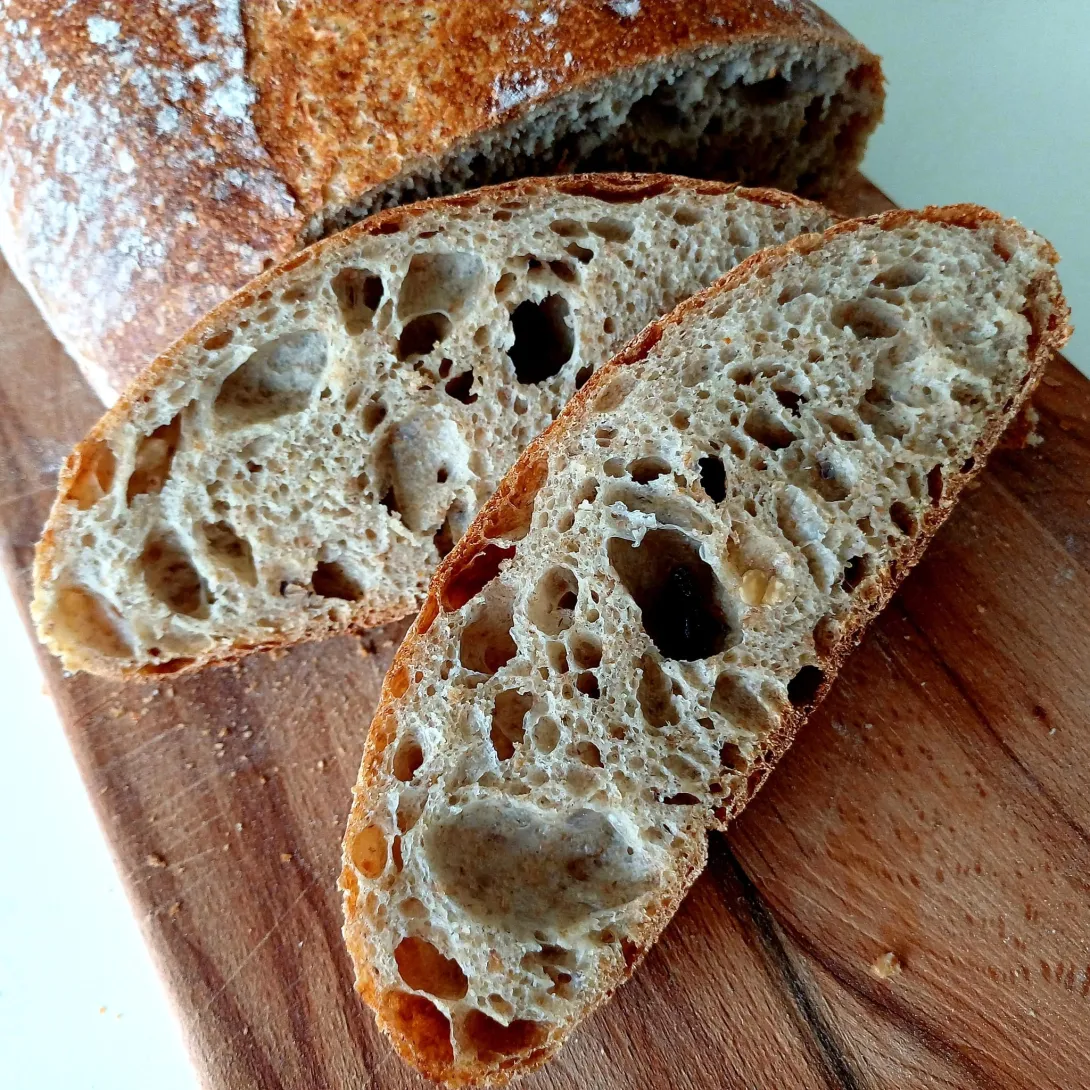
The biga fun continues. This time, I decided to pre-ferment everything. 50% whole rye in a SD crumble biga (45% hydration), and 50% bread flour in a IDY poolish.
The next day, I simply combined the poolish and the biga and added salt. Given that this was a 100% preferment, the bulk was really short - 2 hours - and I concentrated on building a lot of strength upfront. Shaped, added the usual suspects, and baked in the dutch oven at 220 degrees with the lid off halfway.
The crumb was astonishingly velvet soft, and the taste of the SD-yeast was a nice change from the usual. I had scored the loaf a little too deeply, so there was no ear, but the spring was plenty.
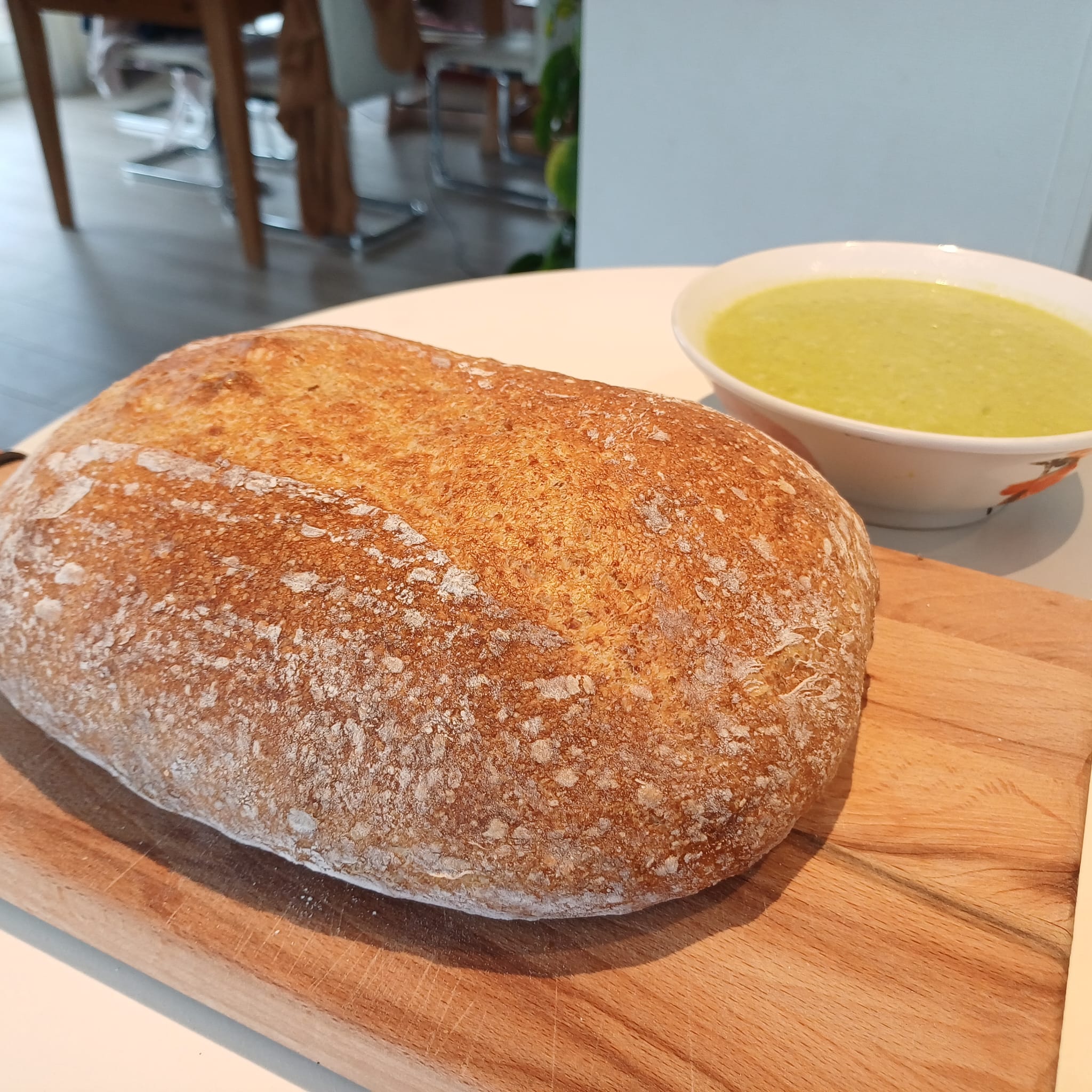
We loved this bread with green pea soup!
- ll433's Blog
- Log in or register to post comments
Wow! I tried the crumble Biga a couple times. I couldn’t get it to work and it was so sour. Obviously I didn’t manage it well.
How do you get the crumble hydrated? I see you didn’t add anymore water . I’m very interested to hear more about your process and pictures if you have time.
Thank you. Caroline 🙏
I found this page, which seems to be about the same thing although more fussy on details -
https://www.stadlermade.com/pizza/ingredients/biga/
TomP
Rene R had posted his method sometime back. The method that ll433 uses doesn’t involve “ soaking” just adding a Poolish and mixing.
My experience with adding anything that is thick/ dry/ crumbly is tiny dumplings . I’ve never had anything except bad results. Also sour after letting a Biga be out for 18 hrs.
That’s why I’m interested in pictures and more detail on her method. I’d like to understand it better. Thank you for the link but it doesn’t cover what this post shows. 🙏
I have been assuming that the soaking time's purpose is just to let the biga absorb water and soften so it's easier to smooth out the clumps.
But the above ll433 posted hasn’t got that step so I’m interested in how the intense working manages to form a smooth cohesive dough.
https://weightloss-slim.fit/comment/550478#comment-550478%3C/a%3E%3Cbr%3E%3Cbr%3EFrom May - Lin did do a short soak. Lots of comments. I still can’t make these drier mixes work.
And this : if I make it the “ wrong” way as noted it works well. The dry shaggy doesn’t like me!
https://weightloss-slim.fit/node/68024/biga-controversy%3C/a%3E%3C/p%3E%3C/div%3E
Thanks for your comments, Caroline! For this bake I simply combined the poolish with the biga. I never have problems with lumps from the biga, so there were no issues with this bake as well.
Actually, the sourness I get from biga loaves is extremely mild, even up to 90% biga loaves. It might be that I tend to use it much more quickly than the traditional 14-16 hours. Sometimes I use it as quickly as 11 hours after making the biga.
It’s quite a nice loaf . I’m glad the building of the dough before hand works so well for you. c
😅 Amazing, Lin. Truly amazing. I've never gotten a crumb like that with 50% rye. It's kinda like the deli rye I make, except totally different. How's the flavor? And what was the total hydration? Did you round up walnuts and dates as the usual suspects? -- Rob
Walnuts have fallen out of favour recently as we had a really bitter batch!
I really enjoyed the IDY-SD combination! Very refreshing - lighter than my usual loaves but with a sour tinge. I don't think I would have believed this was 50% whole rye if I hadn't made it myself. But the real winner was the texture - really soft but with a good bite. The total hydration was 72.5%.
Astonishingly crumb. And lovely with the hazelnuts and cranberries (and soup)! Superb.
I'm going to have to wake up my raisin yeast water to give this a go.
I'm guessing the hydration of the poolish must have been 100% for the math to work out.
Do you let the biga sit in the poolish before stirring? Did you have to squeeze out the lumps? A little baffled how that side of it worked out so well, and any details you have to share would be great.
-Jon
Really happy to read your comments. Would love to see how your loaf turns out.
Yes, the poolish was 100% hydration, so 200g bread flour, 200g water, a speck of IDY (0.3g or so?). The biga was 45% hydration, so 200g whole rye, 20g of 90% hydration starter, 80.5g water. I first mixed the starter into the water, then dumped the flour on it, then used my fingers to make the crumble. Perhaps of note is that I almost never have lumpy bits - just dry sandy, mini pebbles. Sometimes, when I use my white bread flour to make a biga, I find that 45% hydration is sometimes a little too high - way too many big lumps, so I do add a bit more flour to make it sandier. Whenever I have big bits in my biga, I know that mixing the next day will be more tedious, so I avoid it.
The fermentation of the biga and the poolish took about 12 hours - the poolish had doubled and the biga was darker in colour. I did not let the biga sit in the poolish - I simply mixed the biga into the poolish, added salt, and went for it. There was nothing special about the mixing - it combined quite quickly after a few minutes and then I just concentrated on stretching it to build strength. There was the odd lump to smoothen out, but these were quite minimal, and in general you may even ignore it during the first mixing as they are very easily smoothened out in the first SF.
I might try this method with my whole red spelt to see how it goes. I'll take some photos as I go along.
I made the same type of loaf today, but with whole red spelt instead of whole rye. Adjustments: the spelt biga turned out a little too wet at 45% hydration, so I decreased the hydration to 40%. Everything else proceeded similarly.
Biga: 220g whole red spelt, 81g water, 20g starter
Poolish: 220g white bread flour, 220g water, speck of IDY (probably around 0.3g)
Overall hydration: 70%
This is what the biga looked like upon mixing:
And 11 hours later:
This morning (after 11 hours of fermentation) I hand mixed the biga with the poolish and added 5g of salt. It became a smooth dough in 5 mins, and I spent a further 5 mins stretching it.
I left it to bulk ferment for two hours with 2 SFs. This is what it was like at the start of BF:
And after 2 hours:
I then shaped it into a banneton seam side up. Left it to proof for an hour and baked it at 220 degrees in a dutch over, 20 mins with lid and 20 without.
Just before going into the oven:
And voila!
The biga-poolish crumb is really lovely!
Lovely loaf, and oddly similar to the rye!
Is the poolish kept in the fridge or room temp and also about 10-12 hours, right?
-Jon
It's about 18-21 degrees at room temp for us now. And yes, 11 hours this time too. It had doubled and was bubbly by then.
Spectacular Lin. Both loaves.
Very inspirational how you keep on pushing the envelope with these techniques.
Will do another biga soon. Need to get some spelt flour to make my much loved and reliable 70% spelt and flaxseed loaf.
I'm so glad I took on your suggestion to try the crumble biga a year ago. At that time it seemed like so much fuss compared to a simple levain. But now making a biga takes me even less time than making a levain, and it's offered so much flexibility in terms of working with high % PFF and weaker flours.
I've always gotten a more open crumb with bigas than levains with the same flours and schedules. But combining the biga and the poolish was something else. I suppose the gluten development of the white flour here was really stretched with the poolish, and because it is IDY and not SD, there was no degradation whatsoever. In the meantime, the SD wholegrain biga gives a huge flavour boost and preserves the strength of weaker flours, especially spelt. It's good fun.
I'm still waiting for my semolina to give your loaf a try! Looking forward to that adventure.
Do post about your 70% spelt if you have the time.
I tried to copy your method Lin, with wholewheat and white bread flour, with the exact same quantities.
For one thing, my biga looked different in the morning:
I did keep it covered overnight, for 10 hours, slightly warmer than you - it was 23C in the morning and started out at about 25 or 26C. I didn't use chop sticks to mix the biga which previously created a slightly finer 'apple crumble' type crumb.
So, as I was mixing it I struggled and struggled to get the lumps out. I spent 30 minutes mixing by hand in the morning. Cursing that I hadn't learnt anything or any lessons about mixing biga. Eventually I got most of the lumps out and the dough had gone from a sticky nightmare to fairly nice, although you can see that even at the time of shaping lumps were still evident:
At the time I was doing I thought it could be 3 things: (1) I didn't mix the biga correctly initially - it was too wet or I should have used chopsticks (2) my flour, although wholewheat didn't have obvious big bran flakes in it, it was fairly fine, and I think it is necessary to have a flour that doesn't form a 'dough' or clump naturally (3) Lin has magic hands. Probably number three!
I did think that 'heron plucking fish out of water' was the appropriate hand movement for removing the lumps eventually. But seriously, too much effort to do all by hand.
The final loaf looked quite nice:
Although the crumb was a touch denser than I would have liked:
As before with these biga breads the salt flavour really came through, even with only 5g of salt. It was tasty.
This bread had ~2.5 hours from initial mix start until it was baked though (so 1h15m bulk, and 1h20 final proof), perhaps I should have been bolder and left it for another 30 minutes before baking and crumb would have been more open.
I dunno, it isn't spectacular like Lin's bread. If it was a singer it would be Van Morrison singing about Jackie Wilson (I'm in Heaven when you smile).
I'm more with Caroline on this, it is a lot of effort and I still haven't learnt the secret yet.
-Jon
The flour Lin uses is very coarse as compared with what I mill . I don’t sift .
My intention after baking for 50 years is to get the best tasting , most nutritious bread I can with the very least effort. I’ve arrived lol. Plop , rest, fold x3 rest “ shape” ( I mostly plop again) bake.
It’s not for everyone by any means but I’m glad I put it out there for those who are interested. It’s great that there are so many methods to choose from. That’s the best thing about TFL . c
And the heron! 🤣 And looks like two cups of tea next to you while you mix. But the loaf looks good!!!
I'm so sorry this turned out a bit frustrating for you! I certainly don't have magic hands. It really must just be that I had stumbled upon a consistency of biga that works well for hand mixing easily from the start, and since then have always adjusted the hydration of my biga to that consistency.
I've used the biga with however coarse and fine flour and never thought twice about it. The only times it seemed slightly harder was with bread flour. And I suppose naturally so, because of the type of gluten it develops, however minimal.
Today I made a similar loaf but I used a slightly higher hydration of biga than I generally would, around 47%, to see what would happen. I got really big lumps rather than the usual smaller pebbles/sand, and the mixing today was harder. So it really might just be about lowering the hydration of the biga depending on the flour used.
I would happily make a video of the process to show how fuss free it is, and that I use it precisely because it is so easy, tasty and flexible, but I think everyone has had enough of biga for a while 😬
Thanks for trying this out, Jon!!
Love your moist open crumb. That soup looks amazing as well.
Best,
Ian
Yes, it's green pea soup once a week here. We love it and it's so quick to make!
so I tried to emulate you, Lin, going for that wide open crumb you got. I made my usual deli rye this way -- 45% rye prepped in a sourdough biga + 35% bread flour/10% malted khorosan/10% whole spelt prepped in a sourdough poolish.
When I mixed it, my biga looked like yours -- lots of large and small pebbles and sand -- but after 11 hours, while yours (the pic of your spelt biga after 11 hours) looks relaxed, mine had no change: it was identical to what it had been at the start (this, btw, is my usual experience with bigas -- for me, they never change, even after 24 hours.)
The resulting dough was surprisingly soft and loose. Normally, when I mix the prefermented rye with the rest of the flours, I have to go to about 80% hydration. But, perhaps because of the 10% malted flour in the poolish, this was super gooey at about 75% hydration, no water added. And, again perhaps because of the malted flour, it started moving super rapidly.
I got a tiny bit of strength from kneading 10 minutes and folding 8 or 10 x over the course of an hour, but then the structure began degrading quickly. I blasted the oven to 450F/232C, dumped the dough out onto a floured sheet, attempted to shepherd it into a boule, and, once the dutch oven was ready, plopped the malformed pile in and hoped for the best.
But the really big interesting thing was the taste. My normal 45% rye has what I would call a deep background sour -- not super prominent but always there giving structure to the bread, like the rhythm section in a 60s r&b tune. But this was different -- a more up-front high-note flavor, more Jackie Wilson's falsetto than bass and drums.
Rob
So, alls well that ends well, if it's a Jackie Wilson bread then it is jiving and dancing?
And I love how this is such a Rob bread with all the chaos and cajoling into a bread shape, and as is often the case it has a surprisingly great loaf as the outcome.
-Jon
thx, Jon, for the pep talk: I'm a sucker for the hero tape -- and I guess, in a way I did pull this bread back from the bubble-gum pop-music graveyard. But honestly, all Jackie Wilson and no band leaves me with lonely teardrops.🤣🤣🤣
Listening to lonely teardrops as I write this reply. I'm so sorry this didn't work out for you! It could have been just way too much SD preferment going on here - you were essentially making a 100% SD pre-fermented loaf! I'm guessing the SD poolish might have degraded 55% of the flour a bit too much, or perhaps the acidity was just a bit too high accumulatively - as you note in the falsetto!
I have not had the courage to make the poolish with sourdough too, but I reckon if I were to do that, I would actually underferment it in comparison to the biga. That way it still has some power to finish through bulk without getting too weak and sour.
And re biga: In terms of appearance, it simply looks darker after it's fermented, and smells strong. Like ripe sour. It sometimes looks a bit puffier, especially if white flour is used. For me a biga at 14-16 degrees for 14-16 hours does produce the results I want, but depending on schedules I do sometimes go for 11-12 hours at a higher room temp. It still works - just as a levain would work before and after its maximum rise with some leeway - but the resulting loaf will be less sour and complex.
Will you not give this...another....try.....?
I think you're right: the acid from the sourdough overwhelmed the flour. The poolish inoculation was 13%, which might have been a bit high. Perhaps, as I noted, the malted flour complicated things as well. I may try it again but, for the moment, I'm probably gonna retreat to the method I stole from Ilya, as my partner requested a less sour and somewhat lighter and loftier loaf (to be fair, tho, she acknowledged that the biga/poolish version was fabulous paired with good gruyère.)
Combining 100% and 45% preferments must be a complete PITA.