
Hi, after ~100 loaves I think it's safe to say that I'm quite familiar with open baking sourdough in a home oven. I use a pizza stone and a tray filled with lava rocks at the bottom, which I pour boiling water over to create steam. It's working fine and gives nice bread, but since it is quite a hassle I have been looking for different ways. I am trying out using a stainless steel mixing bowl as a cloche, something which is done quite regularly and with good results, if I need to believe the internet. For me, it's not going so well:
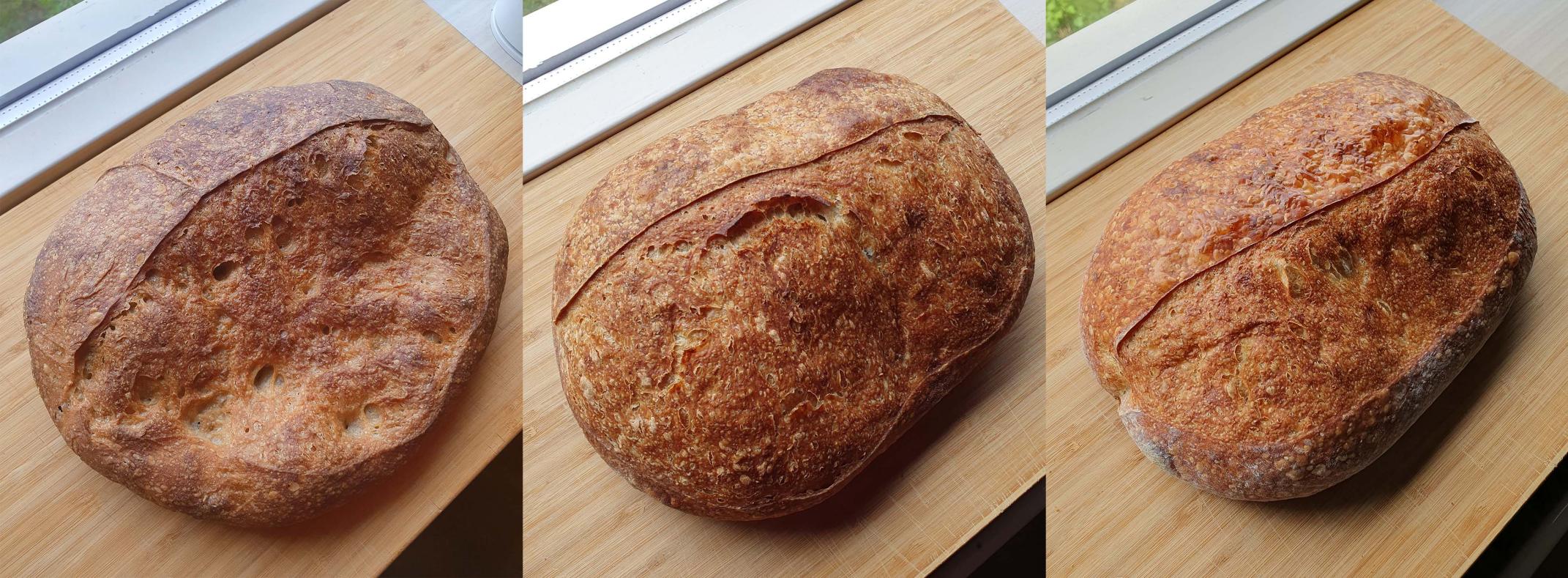
Loaves baked with stainless steel bowl as cloche.
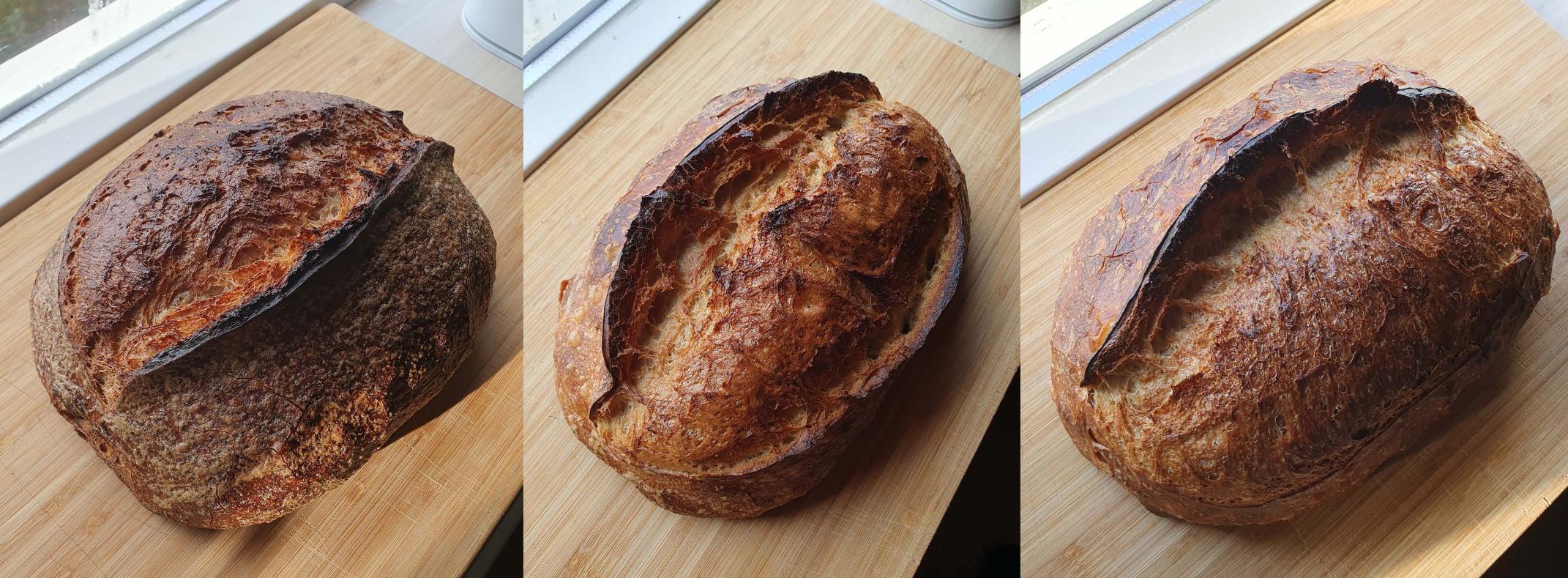
Loaves baked with open bake method.
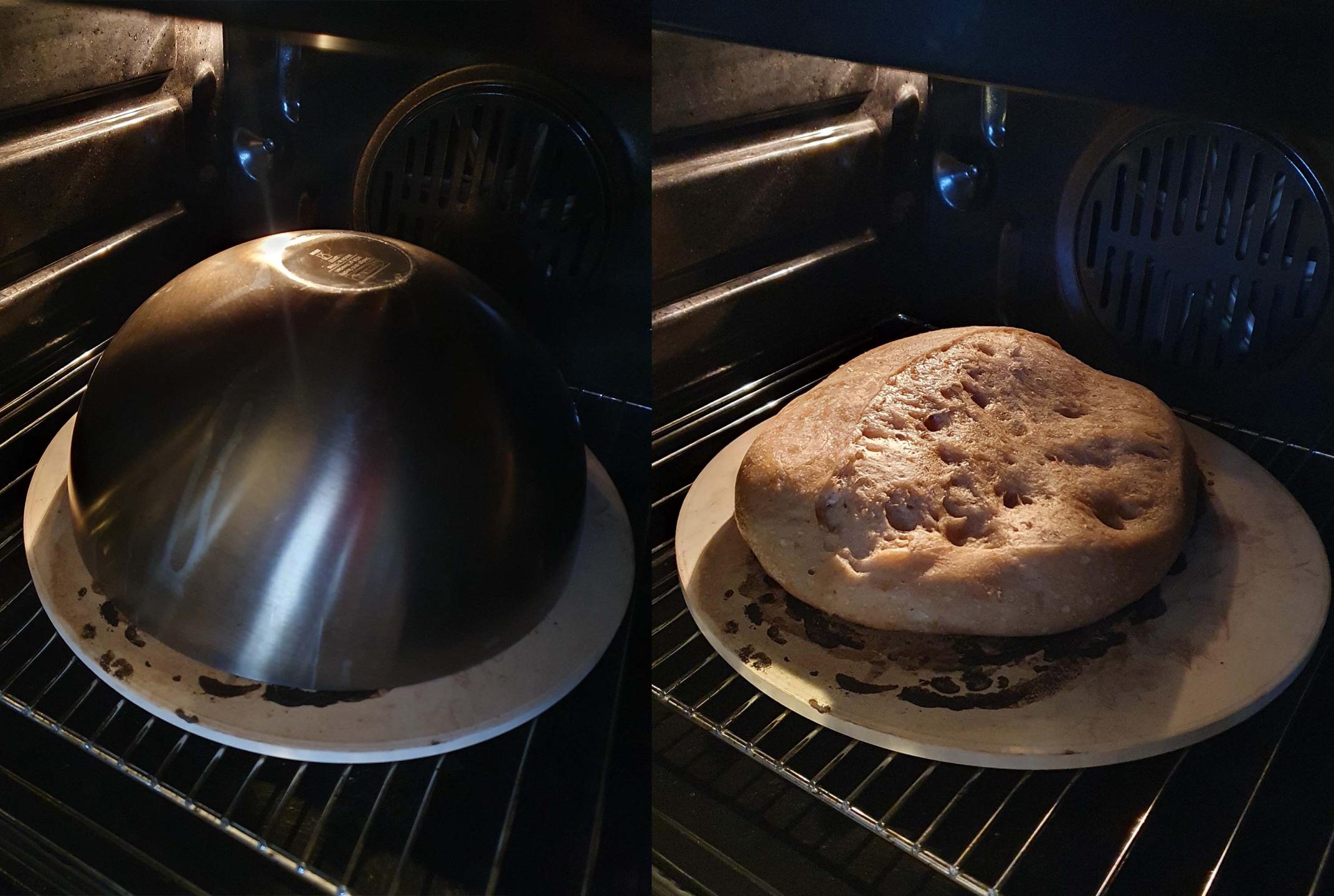
All my loaves baked with the stainless steel bowl turn out extremely flat and sagged. Preheating the bowl or not doesn't make a difference. The color difference I understand, as the bowl protects the dough from the upper heating element of the oven during the first half, but I don't understand why they all turn out like they have melted...
Thank you!
J
Did you leave the bowl over the dough for the entire bake, or only the first ~15 minutes? I wonder if changing the timing of how long the bowl covers the dough would allow the steam under the pan to set up a good crust, but then dry out when the pan is removed to harden the crust and allow for nice ear formation.
When open baking I usually do 25 min with steam and then 25 min without, I used the same approach when baking with the bowl
A granite ware roaster top over the loaf and sometimes I put the loaf in the preheated roaster. With either method I preheat at 375-400 and bake covered 20 min / uncovered 25 min based on the weight of my loaf.
They are always perfect. Try this method . I can’t think what else is going wrong.
Your original method is a lot of work but the loaves are certainly beautiful.
Thank you. I have seen many others using a roaster pan succesfully too. The only difference I could think of is that since it is black (and perhaps a bit more heavy?) it might absorb the heat better rather than how the stainless steel bowl might reflect it away. But since there are also plenty of other who are using a reflective bowl succesfully, I don't understand why it wouldn't work for me.
These two roasters are quite light weight. The color probably does impact. I have only bottom heating element. I have the capability of turning the fan off/ on whenever. I always have it on just as a matter of course. It turns off and on automatically as it’s a gas range so when the heat kicks on the fan goes off till back up to temp. That seems to do a good job regulating.
Hope you solve your issue.🙏
It appears to me that there is not enough heat going through the stainless steel bowl to the loaf, and perhaps not enough from the baking stone to lift the bread in the initial 15-20 mins for the loaf to bloom through the score without a strong heating element from above (or around). I've definitely baked with a stainless steel pot over my loaves, or with my loaves in the pot, without issues, though they don't seem to rise as much as using copper or cast iron.
Ideas: 1) Worth trying another stainless steel vessel as a cloche, perhaps a larger pre-heated pot? 2) Worth trying the same set-up, but with the baking stone heated up for a longer time? 3) Perhaps using a stainless steel pot to put the loaf in and cover with a lid initially?
Can you provide some more info regarding how the crust and crumb of the two baking methods compare? Are there any cracks or bursts in the stainless steel dome loaves?
There have been some debates here on TFL about the relative importance of convection vs. radiant heat in bread baking. Without wanting to stir-up a hornet's nest about the issue, just wondering if the stainless steel dome is actually reflecting away radiant heat from the top element. Since the bread is covered and you don't need to worry about loosing steam through any venting, maybe try the fan oven setting with the dome on and see if it helps.
I use a DO and it is always with the fan function of the oven.
It's not necessary to even use the top element to get a good rise. For open baked loaves on a baking steel, I routinely turn the oven setting down to 250 or 300 deg F after inserting the loaf and generating steam. I may not turn the heat back up for 15 minutes. The bread bakes as quickly as if I had left the setting high all the time. To make this work, the steel has to be very thoroughly heat-soaked so a long preheat is necessary.
We want the base to pump heat into the bottom of the loaf effectively to cause rising, and we want the top to stay relatively cool, moist, and become gelatinized so it will remain soft and expandable as long as possible. Something is interfering with that progression. Here are some possibilities that I've thought of:
1. The bowl doesn't seal as well as it might, so too much moist air is leaking out and the loaf's surface dries out too soon; This could be checked by pressing a ring of unleavened dough or crinkled aluminum foil around the rim before inverting the bowl over the loaf. The ring would act as a gasket. This kind of a seal is sometimes used to make sure that moisture doesn't leak out of a Dutch oven or similar vessel in cooking stew-like dishes, so it could be worth trying.
2. The bowl is thin and reflective, preventing it from warming up quickly enough and holding heat when it does. One would think this would be a good thing but maybe it's too much of a good thing. It could be worth lowering the preheat temperature before trying again. My Pullman loaves bake well (lid on) at 375 deg F in my countertop oven whereas open bakes in my main oven usually want higher temperatures.
3. Try using a glass oven-proof bowl instead of stainless steel. If radiant heat does have a part to play this should maximize it. Someone posted here recently about using a glass bowl this way with good results, I forget who. One negative is that handling an upturned hot glass bowl could be tricky since these bowls are heavy and slippery.
Unfortunately my oven doesn't do bottom element only, unless it is with the fan on as well. I preheat on max temp with both top/bottom elements + fan, and then do the actual bake with just top/bottom heat. I sometimes also turn my oven off completely during the first half, the baking stone esentially does all of the work indeed, so I'm sure it is preheated plenty.
It might be good to know that I bake directly from the fridge, so the loaf might cool down the air around itself quite a bit. In conjunction with the bowl reflecting away the heat, it might just not get hot enough under there...
I would like to stay away from glass as much as possible, particularly if it is going to get hot, though it could be quite helpful to be able to see what's going on.
Crust of the stainless steel bowl loaves is definitely a little more chewy and leathery, and not as 'splintery' as the ones which are open baked. Also, while cooling down, the crust stays intact while the open baked loaves develop a lot of cracks; probably because they actually have risen (unlike the loaves baked with the bowl) and their inside is contracting again.
Interesting, I might give it a try with the fan function. Thank you!
I use either method at home depending on whim and desired outcome. I think the level of proofing you are used to giving good results with the open steam method would be overproofing for the cloche method.
Especially if your oven is drafty and/or not that well insulated from the extreme heat of the heating elements, you can get the best results from a loaf that is almost overproofed using the open steam method. The excess of fermentation gasses trapped in such dough will force expansion, while the drying environment of the oven (unless you employ extreme measures like blocking your oven vent with wet towels in addition to ample steam) will set the crust before it has a chance to collapse entirely. If your loaf is thoroughly overproofed, you can actually salvage good results by forgoing steam entirely for this same reason.
With the cloche method, you really trap a ton of moisture, so the bread will have a tendency to expand to the full extent of its potential. Even slight overproofing in this case will punish you with a flat and/or over-opened score. To get good results, err on the side of less proofing, and make sure not to score too deeply. Honestly, I prefer to employ a scoreless, seam-side-up bake for natural opening for this approach. Hope this is helpful
Interesting take, thank you. I do think my oven traps steam quite well, but probably not as good as a cloche. I'm not sure if only the dough being slightly overproofed would cause these weirdly melted loaves though. I would assume they would then just rise a little less than when open baked, but look similar for the rest. I have never tried baking seam side up or without scoring. Could be fun to try some time!
I'm sorry, I missed your response in this thread where you indicated that you keep the loaf covered for 25 minutes. I agree with the commenter above that it is oversteamed! I have the best results from 12-15 minutes covered with the inverted mixing bowl trick, personally.
It looks over-steamed. Covers are used in ovens that can't hold steam to give the loaf a chance at a decent oven rise before the crust sets. Since you can do open bake it means that the steam under the cover never really escapes and the loaf gets drenched.
PS. I would so love an oven that can do open bakes.