
Hey there,
I am sure you've had this question a million times, but would appreciate any advice given.
I am currently making Sourdough and am utilizing the below process, but as you'll see below I am churning out much more dense bread.
My recipe is:
- 100g starter
- 350g water
- 500g bread flour
- 10g salt
My process is:
- Mix together the above - I typically mix the water and salt first, then the starter and flour last.
- I mix them well together, let them sit in the bowl for 30 minutes
- Then over 4 intervals each spaced out 30 minutes apart I stretch and fold and turn the bowl.
- I then let it sit in room temperature for usually 4 hours
- After letting it sit, I put it into a bigger bowl with a flour'd cloth at the bottom and let it rest in the fridge overnight (this last time the dough somehow got stuck to the towel?).
- Also here I fold it and tuck it in
- To bake:
- Dutch oven in oven for 1 hour at 450
- I've done either straight from fridge to dutch oven, or room temperature rest to oven (mixed results quite frankly).
- 20 minutes at 450 top on
- 20 minutes at 450 top off
- rest minimum 1 hour
My most recent one below sat out two hours post fridge overnight:
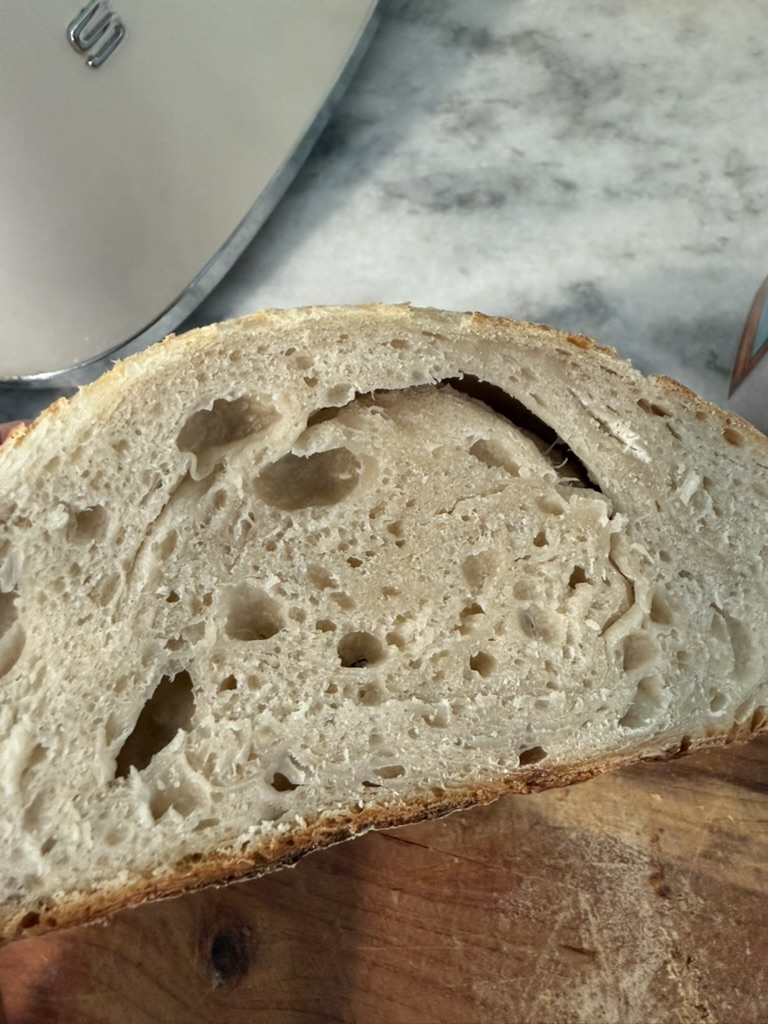
Any help is greatly appreciated!!! Thank you!!
The picture looks underbaked and under fermented to me. Otherwise, everything you wrote seems right on.
Next time, could you include a picture of the overall loaf, please? That can give some more clues.
TomP
Dang I forgot to take an overview one but will do!!
Should I let proof longer and add 5 minutes to top off bake?
First - let it rise - if you are using a starter (not added yeast). For the times given you could use more fermentation. So - let it rise more or use a starter (stronger) that fits your baking style. Enjoy!
PS - you really should "mix" for a short period. Like a couple minutes and then let it double - mix - double - etc. And I should note - I do not use the fridge.
I think my starter is becoming pretty strong, I am about 1 month + into feeding it, it grows pretty solid.
When you say mix are you talking about the original mix of the flour + starter etc?
Thank you so much!!
If you're talking to me - mix is all ingredients added together. Enjoy!
I agree with TomP that it looks underfermented (which can also contribute to less browning during the bake). So, a few questions:
Rob
THANK YOU!!
Sounds encouraging. But from your photo of the dough after 6 hours, I'm gonna agree with Abe. By that time, if your starter is healthy and you're using a high quality bread flour, the dough should be well on its way to being plump.
Rob
I am thinking I mess up the aerated part - is there such thing as too much? I could leave it out overnight or just longer in general?
For instance today I have had it on there for 6 hours. I believe it has grown a decent amount, I wouldnt say it is puffy. I can tough it with my finger and it doesnt push back necessarily quickly, but does recover to its shape.
Thank you!
How old is it? What is a typical feed and how long does it take to peak? What water do you use? etc...
Watching several videos (even shorts) on making sourdough could help you learn what “aerated and puffy” generally looks like. Caution that not all videos are going to show a process done well; don’t assume everything you see is done by experts, hence watching several videos.
Here is 6 hours post stretching sitting on counter covered cloth.
Without seeing all the stages it still seems a bit lack lustre to me.
If this is 6 hours with 20% starter then I think you need to look at your starter.
Check back in a few weeks. It'll either be dead - or it'll work. Enjoy!
Hey some good news, my next one went I would say decently well, it was far less dense than prior versions. I had a big air pocket at the top but honestly I think the suggestions about the issue being my starter is accurate. I also came back to my starter really going and now I think my next loaf will be way better.
Below is the most improved so far. I forgot to score it of course.
I now think my starter is actually awesome, below is a picture of it. It was literally growing out of the jar now when I feed it.
Honestly I think the starter appears to be good but the dough needs a lot more time.
What is a typical starter feed and how long does it take to peak? What water do you use for your starter and dough?
Several people have mentioned that the bread looks under-fermented, and I totally agree. However, 6 hours should be plenty of time for bulk fermentation if you're adding 20% starter and the starter is as vigorous as it looks in the photo. So the other question is, what does room temperature mean to you? And what temperature is the water that you're using to make the dough? If it's not fermenting fast enough, it may be too cold, in which case it would help to warm the water up to 85-90F before mixing it into the flour.
Regardless of that, the bulk fermentation isn't done until the dough is visibly aerated. Different bakers will give different endpoints, but I typically end my bulk fermentation when it has doubled in volume. Some would say 1.5x, especially if they want to err on the side of under-proofed to maximize oven spring, but whatever rise you're getting, you need more.
Finally, what temperature is your refrigerator? If it runs cold, you might be retarding the proof too much, even with an adequate bulk rise. In that case, it would be helpful to let the shaped loaf sit for an hour or two on the counter before going into the fridge, rather than after.
I would not add the salt to the water. That will limit the starter's ability to grow. Even on my other recipes I do not do that.
Put the water in the mixing bowl.
Put the starter in the water- (starter =75g water mixed in walnut size mother add 75g flour mix let sit 8-12 hrs)
You can mix the starter into the water or leave it alone.
Put the flour on top of water/starter
Put the salt on top of the flour.
Mix.