
OK I found a recipe that is a form of 123. I will put the link at the end here. I did not follow it exactly. I always put the starter I fed and left out to bubble up into the water before adding the flour then salt. It says to put starter in after allowing the mixed flour and water to sit for 30 minutes. I refrigerated it overnight. The next day it did not seem impressive. I baked it as in the recipe. It was OK looking one part seemed undone. I put it back into the now turned off oven, directly on the rack for another 15 minutes.
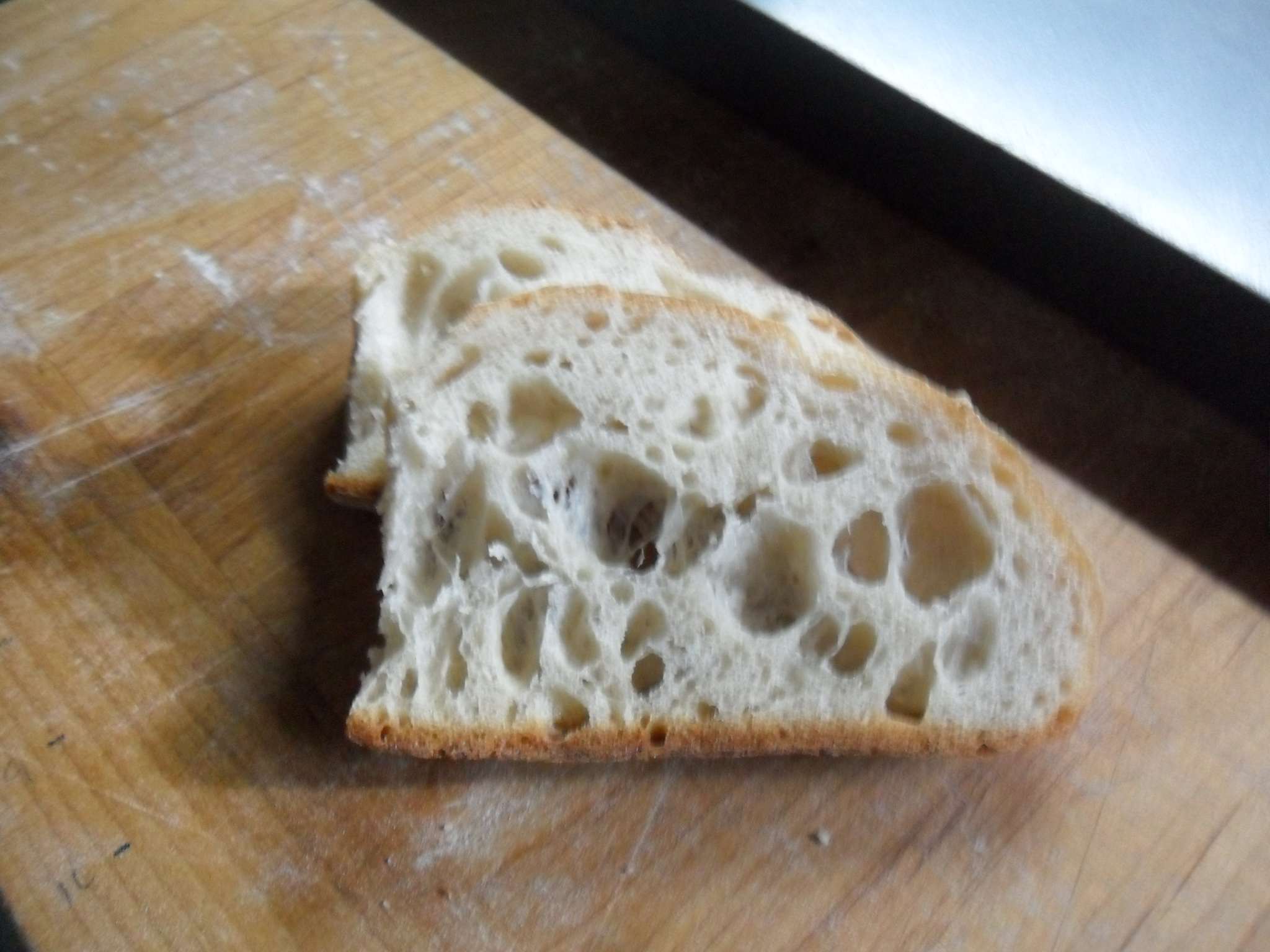
Well it has lots of air pockets but felt mushy maybe not cooked enough. and he bottom was hard. I bagged it with a tiny bit if residual heat in it. The next day it was dreamy to cut and toasted well and had way more holes than I could have hoped for. I have two slices left I will try to take picture.
OK I want to make my sourdough sour. Since I first made the mother in 2014 it has always given me sweet flavour. One rye loaf tasted slightly sour with butter. So that could have been the butter being sour.
I decided to try vinegar but I cannot find actual charts or instructions for how to determine amount to add.
Can anyone just tell me the way you determine how much vinegar to add?
I don't use vinegar - but if I did I would start with a little. You can always adjust later. If it really is vinegar - watch it - you are adding a component (namely acid) and things can change. Enjoy!
Let ferment at room temperature for 20-24 hours (until ready!).
You can use up to 21.6% vinegar in a sourdough rye, but only about 5% in a standard sourdough, and these are maximum numbers here.
How much to add... Well I first asked google how much acetic acid was in various sourdoughs then a calculation had to be done based on storebought vinegar that has 5% acetic acid content and the rest water. I'm sure you must know to base this from your total flour weight in the recipe, and from that you calcuclate the percentage. Were working in grams here most likely. If you have 500 grams of
flour in your recipe and want to do a rye. It worked out to 21.63% maximum amount of vinegar to add to that recipe for the
most sour desired that is acceptable. Calculate that and that would be the grams of vinegar to add in and include with your water. A standard sourdough was about 5%. Rye is the king of sourdoughs. Hey you can get a lot of answers today asking google and A.I. responds with details! But this vinegar thing has been working for me, I like it. You can control this method very
precicely. It's all the same stuff, so what's the big deal...I dont need a cooler for my yeast/bacteria to battle it out and make some unreliable amount of sour. Oh, be sure to add that with your water, hey it's wet you know.
Thanks folks. I am not so good a baker that I am precise :-) I just want my sourdough to taste sour.
I made the 123 (100g starter, 200G water, 300G flour) recipe right after posting. I used 20grams (ish) apple cider vinegar as part of the 200g water. It smelled nice and pretty much acted the same as the previous loaf except it was very wet. I had to add 40g or so more flour and it was still sticky There is no appreciable difference in the flavour.
The only time I ever got sour flavour was using saved discard per "The Bread Code" on YT. But that was a very dense loaf and too sour for me. I had no ambition to try again since.
BTW I took his advice on making the mother more liquid, it is more lively.
Another consideration in the sour flavor in sourdough is lactic acid. There is actually a lot more lactic acid in SD than acetic acid (vinegar).
I also have been unable to produce the sour flavor in a white flour SD. I have no problem getting sourness in predominantly rye loaves, but not in the white. My experience is that is difficult to add acids to the dough to get a more sour flavor without affecting the structure of the dough. I have tried adding vinegar and lactic acid to the dough, but also got sticky dough. The stickiness may be gluten breakdown caused by the acids.
Rye flour is ALWAYS sticky, unless it is in a very small percentage. Adding more flour will not change that much. It will only affect the density (as in, it will make a brick). Are you doing 100% rye flour when you use the 1-2-3?
Here is a link for MiniOvens fabulous 100% Rye ratio loaf:
https://weightloss-slim.fit/comment/110751%3C/a%3E%3C/p%3E%3C/div%3E
Initially I used to mix my dough and typically add more flour and knead and scrape down the bowl sides and all that stuff and
try to get the dough to behave as a ball. Then I would take a dry hand and press it against the dough and If I could remove my hand
without stickyness pulling away and stuff being on my hand, I considered it ready to transfer to the bulk proof bowl. Now I go for a bit
more sticky and want stuff to come off on my hand and have to wet my hands to handle it. More elasticity yet having developed gluten
means the gasses from the yeast can expand that more flexible ball of dough and it will rise more. Oh, and the vinegar thing, it has
been working great for me.
I don't make much rye anymore. I had the same problem getting sour flavour. Haven't bought any rye flour in a year. The recipe I used came out very dense. I added AP flour to get some rise. It rose more. I tried using rye in the mother to get more life and or sourness with no luck. I now use WW flour to feed the mother more often than I use bread flour and keep it pretty liquid.
Stickiness is not a big problem to me these days. I add flour as needed. Now that I am closer to the middle of this vinegar loaf it is denser but still good.
I have learned to mix the ingredients until they come together then set the timer for 6 minutes and mix with my 4.5qt kitchenaide @ half speed. That will pull it from the sides and the bottom will still be stuck to the knob down there. then 3 minutes at high speed and @ about 1.5 min that will pull it off the bottom and by the 3 minute mark it will be a ball.
If it is sticky and you need it not to be, slow it down (extend the 6 minutes) and add spoons of flour until it looks good for you. It usually needs to be wetter than you think. :-)
I generally follow what I have found to be the counterintuitive inverse proportion rule: if I want more sourness, I use much less sourdough starter & give the dough much more time to ferment. -- Rob
If you add vinegar you don't really need sourdough, might as well just do straight yeast dough, IMO. If you want naturally-developed sour, - low inoculation and long room temperature fermentation worked for me. Overnight cold proof also tend to produce more sour taste. Adding whole grain may help. However, it all hinges on your starter - if it leans heavily towards homofermentative, lactic only, the taste will always be on the milder side.
You can control the sourness of your starter and therefore bread with how you maintain your starter.
This is a good read:
Bacterial Fermentation
Bacteria are primitive one-celled organisms. The types of bacteria common in bread dough consume the same simple sugars used by yeast cells. The primary by-products of bacteria in dough fermentation, though, are two types of organic acids: lactic acid and acetic acid. Lactic acid is also found naturally in milk and in concentrated form it produces the tangy flavor we find in yogurt. Acetic acid is found in all varieties of vinegar and is more sour than lactic acid.
ORGANIC ACIDS PROVIDE STRENGTH AND FLAVOR
The types of bacteria that produce these acids can thrive in temperatures of 50-90F and are collectively referred to as lactic bacteria. As bakers, we are concerned with two types of LAB, homofermentative and heterofermentative.
These names may seem hard to pronounce and even harder to remember, but it is important to identify them and explain a bit about their behavior. Yeast must be regulated to control how fast the dough rises, but the bacteria primarily determine how well your dough will mature and how the bread will taste. If you want your bread to develop good handling properties naturally and to taste good, you must pay as much attention to the quantity and type of bacteria in your dough as you do the activity of the yeast.
This is, perhaps, the one concept in artisan style baking that escapes bakers who look for easy, time saving ways to make bread. Unfortunately, bacterial fermentation almost always proceeds more slowly than yeast fermentation, much more slowly. Scientist have successfully isolated strains of the yeast saccharomyces cerevisiae that can speed carbon dioxide production considerably. Lactic bacteria have so far been much less cooperative; the bacteria in bread dough we make today probably aren’t different from those present in the times of Moses.
HOMOFERMENTATIVE BACTERIA
Homofermentative bacteria prefer environments that are wet and moderately warm, perhaps 70-95F. Their chief by-product during fermentation is lactic acid which is fairly mild in it's sourness compared to the sharper acids contained in lemon juice or vinegar. Homofermentative bacteria can survive in somewhat drier conditions and within other temperature ranges but they do better in the warmer range.
HETEROFERMENTATIVE BACTERIA
Heterofermentative Bacteria do better in somewhat drier and cooler environments, they prefer temperatures of about 50-65F. They produce both lactic acid and acetic acid as by-products as well as a small amount of CO2. Acetic acid is also found commonly in vinegar and it’s flavor is much sharper that that of lactic acid. Heterofermmentative bacteria can survive in some numbers as different temperatures than specified and in wetter environments, but drier and cooler situations favor their reproduction and their ability to ferment bread dough.
Daniel T. DiMuzio, Bread Baking.
I have never found much correlation between the sourness of a starter and the sourness of the bread it makes. Mostly I make bread at room temperatures (70 - 74 deg F), and sometimes retarded in the refrigerator.
TomP