
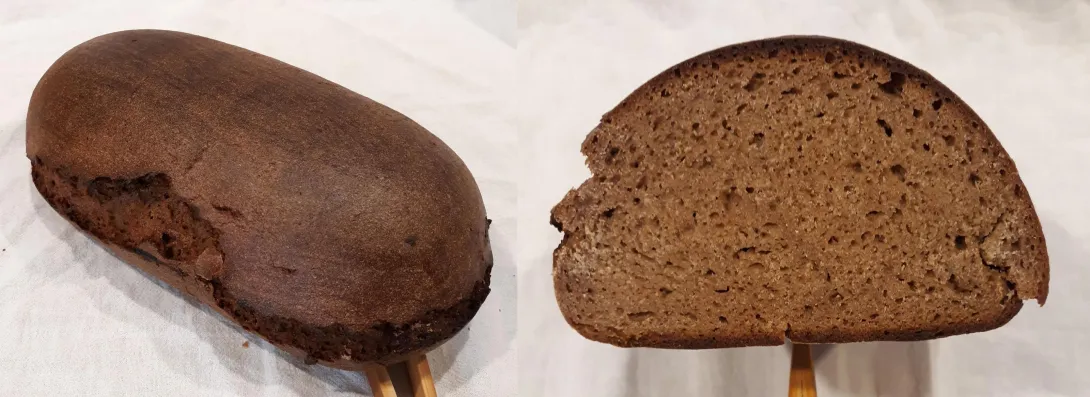
Jēkabpils Rye is another delicious custard bread from Latvia. I found this recipe on Sergey Kirillov's ХЛЕБ & ХЛЕБ (Bread & Bread) blog; Sergey, in turn, sourced this recipe from "National hearth bread made from rye flour. RST LatvSSR 815-78" Official edition. State Planning Committee of the Latvian SSR, Riga, 1978. This bread is typical of many Baltic ryes that have multiple stages. These stages include preparing a thick rye sourdough and a separate multi-hour rye flour scald; fermenting the scald with the sourdough for several hours; and, finally, preparation of the dough.
I tried Gary Bishop’s suggestion to use Google NotebookLM to prepare a translation and summary of the process. The AI is a little chatty, so the summary is five pages long! (Google Drive link). Here are the quantities used for each stage:
| Whole rye flour | 25 g | 3.8% |
| Water | 14 g | 2.1% |
| Rye sour culture | 37 g | 5.6% |
| Whole rye flour | 170 g | 25.9% |
| Boiling water | 379 g | 57.8% |
| Pale rye malt | 19 g | 3.0% |
| Sourdough | All | — |
| Scald | All | — |
| Instant dry yeast | 1.1 g | 0.2% |
| Sour-scald | All | |
| Whole rye flour | 442 g | 67.4% |
| Water | 55 g | 8.4% |
| Salt | 6.3 g | 1.0% |
| Sugar | 25 g | 3.8% |
The sourdough was prepared as described in the blog, except I used more water to compensate for my culture being 85% instead of 100% and was fermented for 5 h. I prepared the scald in a glass dish and used rye malt instead of whole rye flour, as did Sergey. The mixture was heated for 3 h in an InstantPot maintaining a water bath at 63‒65 °C using the Keep Warm setting. The scald becomes much thinner and darkens some during the heating period.
The sourdough was combined with the cooled scald and heated for 16 h in the InstantPot water bath at ≈30 °C using the Yogurt-Less setting. I watched this step for several hours and stirred it occasionally to knock down the bubbles and it seemed to have settled down. But the next morning, I found that some had overflowed even though it was a 1.7 L dish.
The dough was mixed (note: I doubled the salt to 1.0%) and the bulk fermentation was extended because the dough temperature was well under the 30 °C Sergey describes. However, I really couldn't tell when the bulk was ready because there was not a lot of expansion. I attempted to replicate the 40 °C proofing conditions with a pan of boiling water in a toaster oven but I could only get the temperature to ≈35 °C. I thought I was seeing some pinholes in the loaf after 55 min, so I figured it was time to bake. The blank was coated with a slurry of rye flour in water (18 g rye flour, 56 g water) and baked for 55 min at 230 °C in a toaster oven; final temperature 95 °C. It was glazed with a cornstarch slurry at the end of baking.
If you ignore the large crack on the side, the loaf looks pretty good. The crack indicates that the dough wasn’t ready for baking and needed a longer proof. The crumb is dense and soft, almost cake-like; no wonder these types of bread are referred to as custard breads. The crust is leathery in a good way; no cracking a tooth on a rock-hard crust like found on some German rye breads.
But the best part about the bread is the flavor—fantastic! The combination of the scald and the prolonged sour-scald really create the flavorful sweet-sour characteristic of the bread. I would still rank the similar Latgalian Rye as slightly better in flavor, but this bread is not far behind. Jēkabpils Rye is well worth the effort.
- alcophile's Blog
- Log in or register to post comments
I imagine that I could reproduce this. I might try it for my friend who can't eat wheat.
Thanks for posting the translation.
Gary
Thank you for bringing the NotebookLM to our attention. I normally wouldn't need to use NotebookLM for Sergey's blog posts because he usually includes stepwise instructions that the browser translator handles well enough. But this recipe was spread over two blog entries that made it difficult to follow. I believe your friend would enjoy this bread, but it is very different from the more familiar German-style rye breads.
Just looking at the photos is making me hungry. Thanks for posting. Gonna try it as soon as I can .... (tho, sadly, it may take a bit of time: a few weeks ago, I had to toss all my flours and my rye malt after a moth explosion in my kitchen cabinets and now I have to find a new stash.) -- Rob
Thanks for compliment. It is, indeed, a "ryeghteous" bread!
Sorry to hear about your meal moth problem. I haven't had one of those in many years. Most of my flour is now in glass canning jars, which are surprisingly inexpensive compared with "regular" storage jars.
I won’t likely ever try it but I sure would eat it! Now that I have a sous vide circulator I could try it but I’m lazy! You did an outstanding job. c
Thank you for the kind words.
I'm basically lazy, even more so now that I'm retired. But even as a manufacturing/process chemist, I was always looking for ways to make my job easier (aka lazy!). But there are times when the extra work pays off, like in this recipe. The InstantPot makes it easier to accomplish and the sous vide would probably work better, with more control. The only drawback is more bowls to wash, but that's what dishwashers are for!
Great outcome, I'd be super happy with this.
Weird that there is so much sugar in the recipe!
-Jon
Thank you! I was really happy with this outcome, too. Just have to get the proofing better.
Most of the Baltic rye bread recipes I have seen use some amount of sugar, honey, molasses, or jam (or even a combination of sweeteners). Some recipes use even more sweetener than this one does. I believe that is what makes these breads so flavorful; the combination of sweet and sour.