
During the last two weeks I revisited the formula posted earlie in my blog:
I won't repeat the whole process here, just as a reminder:
Added a comment with another take on this formula (30% rye), now with crumb shot:
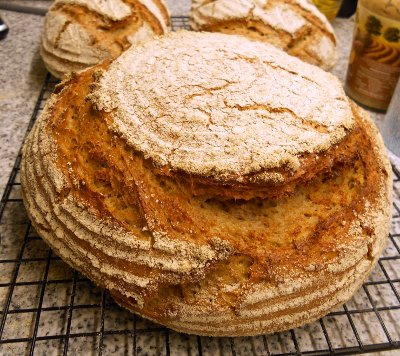
This bread is based on the "Mischbrot" with 50% rye.
Wholegrain Rye 23% ( used in preferment)
(Almost) Wholegrain Wheat 21% (Shipton Irish Soda Bread flour)
The process is as in the above post.
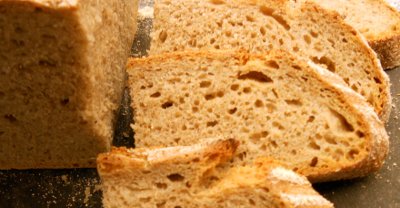
Very deep, rich flavor, and a surprising lightness.
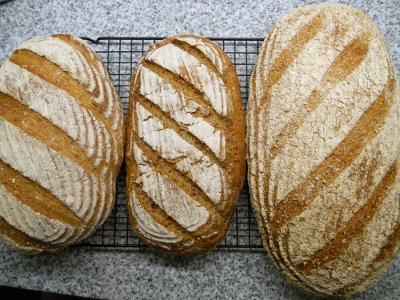
The following pictures shows the results of another bake, from left:
An experiment with desem type starter, 100% wg wheat (scaled at 1500g)
Here the crumb shots, from left:
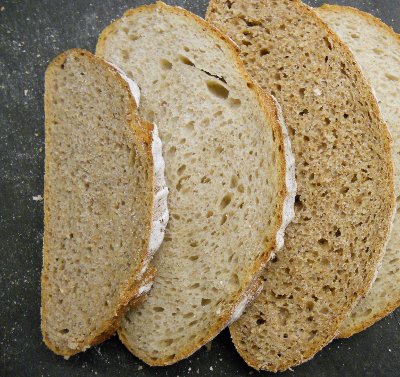
Wholegrain Rye 28% (from preferment at 80% hydration)
Wholegrain Rye 20% (from preferment at 80% hydration)
100% Wholegrain Wheat with desem starter
- Juergen Krauss's Blog
- Log in or register to post comments
Wow! Nice scoring. And great crumb, too. All in all, very handsome looking loaves.
Best,
Syd
Syd, The scoring of the 70% loaf always goes a bit wild with so much bran in the dough (my rye is quite coarse). This time it made for a great effect.
I updated the post with a crumb shot and the details of the second batch.
Thanks again,
Juergen
Hi Juergen,
Thank you for showcasing a range of lovely breads.
I take it that the Shipton flour has not been treated with Bicarb. It is unclear on the website. This would not be conducive to creating good bread.
Regarding the Desem, have you invested in a mill of late? It is a bread I've wanted to make since first reading Wing and Scott's book "The Bread Builders" some years ago. However it appears that it is all built around using freshly ground wholewheat flour, and I very rarely have access to a mill.
All very good to see and read about; very best wishes
Andy
Hi Andy,
Your kind words are very much appreciated.
From reading Shipton's web page I somehow got the impression that it is just flour, not a baking mix.
It has quite a soft feel to it, and it seems to perform nicely. I'll put it to the test on its own on next weekend.
With regards to the desem, I didn't do much research. I got inspired by some recent posts, and as I don't like the taste and smell of my wg wheat starters at room temperature too much (I always get the feeling they are slightly out of balance, although they perform well) I just was intriegued by the cool fermentation of a fairly dry mix. Suepke says 24C is cold for sourdough, the desem I read needs 18C or below. And at 50% there should be plenty of acetic acid.
True. This was the most vinaigry thing I made so far.
But the finished loaf was well balanced, quite mild, actually, and developed its taste over the course of 3 days.
On day 4 ALL my bread in my box was mouldy due to our current crazy weather.
Anyway, I'll use this method in the future if I want to make wg starters, and I'll do more research about desem.
I have got an old Jupiter handmill and would be ok to grind small amounts of grain (I broke one in the past attaching an electric drill - I now appreciate the limits ...)
Thanks again for your inspirations,
Juergen
Great scoring, great rise. Perfect ! :)
Anna
This is it!
My parents liked it very much.
Thank you, Anna.
For this one I used the process for 30% rye in the blog I cited above, with the following modifications:
1. No added yeast, it was hot in our kitchen (28C)
2. I used wholegrain rye for the starter and medium rye for the rest of the mix.
* UPDATED *
Here is the crumb:
The loaf:
Thanks for posting and for sharing your recipes. Nice scoring and great looking crumb you achieved on all three.
Larry
it caused a bit of a stir among my customers at the office.
Thank you, Larry, for your kind words.
I enjoyed your "Rye or Rut" post.
Juergen