In my quest to unlock the mysteries of bread-making I ran across a video of King Arthur Martin where he effectively handles a 100% hydration, sloppy dough. When he said “use strong bread flour,” my reaction was to move on. As soon as any of these celebrity bakers mention strong flour, I turn off knowing anything they say from then on will be irrelevant to my situation.
But then I drew similarities in his technique to that of Solano in Brazil who seems to have mastered weak flour so I was curious and took a second look at Solano’s post.
https://weightloss-slim.fit/node/57279/100-white-weak-flour%3C/a%3E%3C/p%3E%3Cp%3EHere%E2%80%99s the list of my ingredients and method based on the above:
320 grams of AP flour (small loaf but that shouldn’t matter?)
210 grams of bottled water (for a hydration of 65%— less than Silano’s 68% and way less than Martin’s 100%)
1/4 teaspoon active yeast
2 teaspoons sea salt
I combined the Blanquita brand flour (9.4% protein), with the yeast and salt, then mixed in the 210-grams of room temperature water slowly until I got a sticky ball. I mixed the dough for 5-min to be sure all ingredients were incorporated then let hydrate for 30-min.
I started with a Bowl-Fold, folding sections of dough from one side into the middle, repeating 12 times as I turned the bowl. After, I allowed the dough to rest for 30-min.
Then I did a Coil-Fold, reaching under the dough and stretching the middle upward until the dough began to tear and rolled it onto itself. I did four coils per session for four sessions, allowing the dough to rest for 30-min between each session.
After the last Coil-Fold I left the dough to ferment for 1-1/2 hours before placing in fridge for 24-hours. The next day, pre-heated oven at 500F for 3/4 of an hour. I don’t have a dutch oven but a good facsimile with an iron skillet and tight fitting, inverted cast aluminum bowl. I also have a steamer bowl in the oven and add a couple of ice cubes to the skillet.
The dough had collapsed during the cold fermentation and was full of mouse-holes. I dusted the cold dough ball and turned it onto a floured peel and did my best to shape it into a ball. Scoring it properly was impossible. I dumped it into the oven and baked at 480F, covered for 20-min and because it was rather pale, baked for a further 24-min uncovered.
Okay, it was a useful experiment. The bread turned out better than expected and I was surprised I could handle 65% hydration with this flour. Just have to figure out the bulk fermentation, I think.
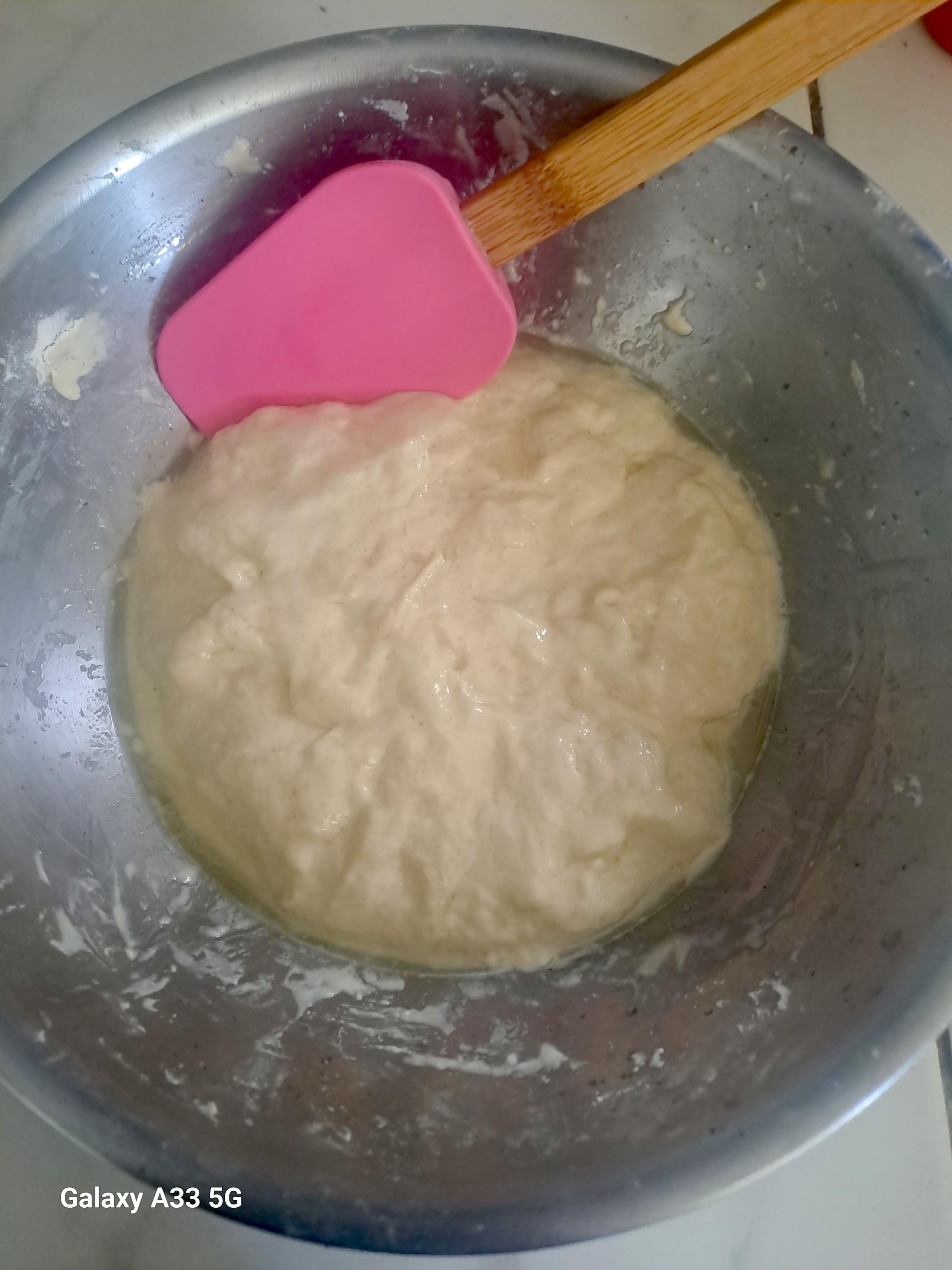
After mixing indredients
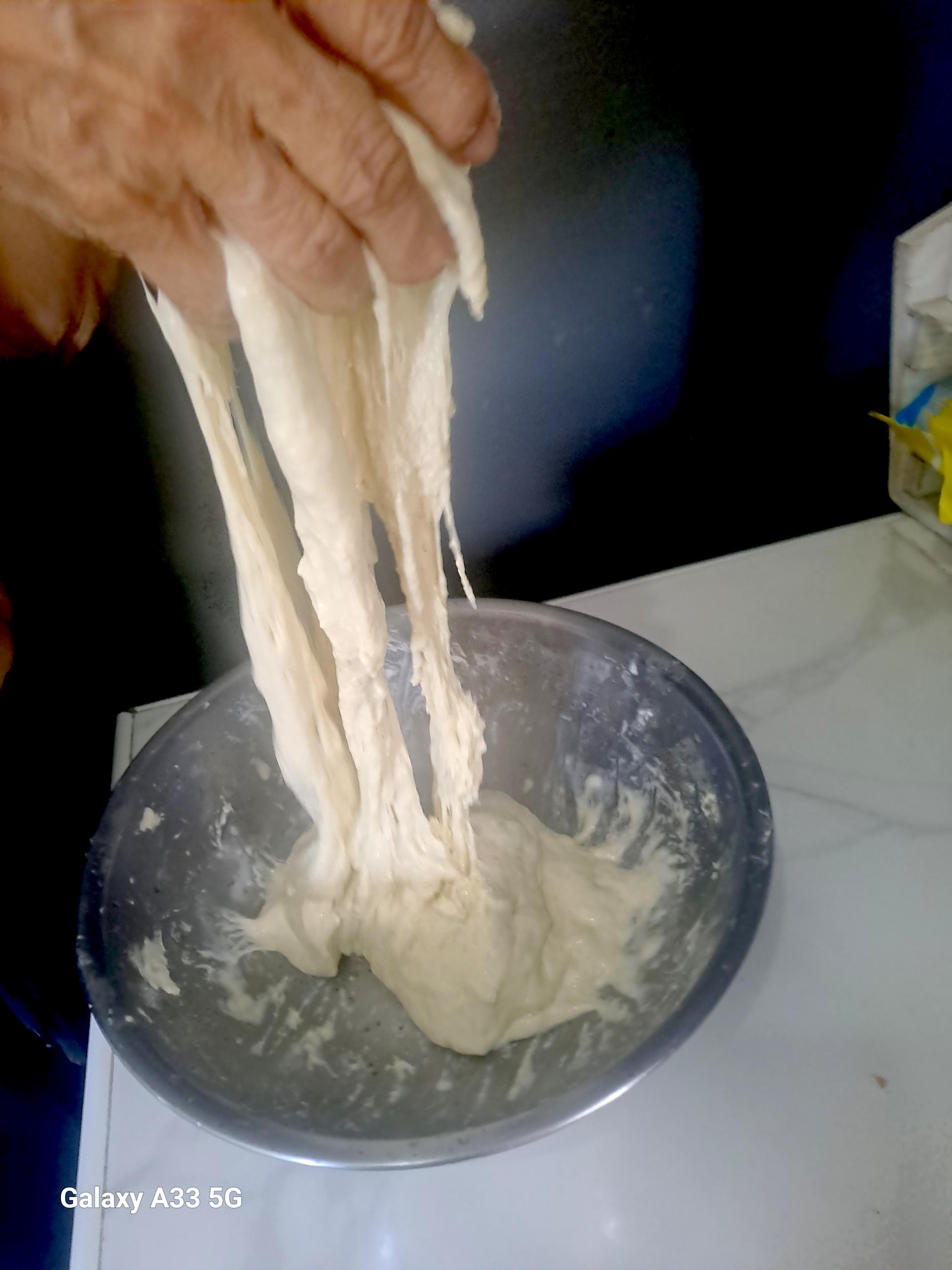
Third coil-fold
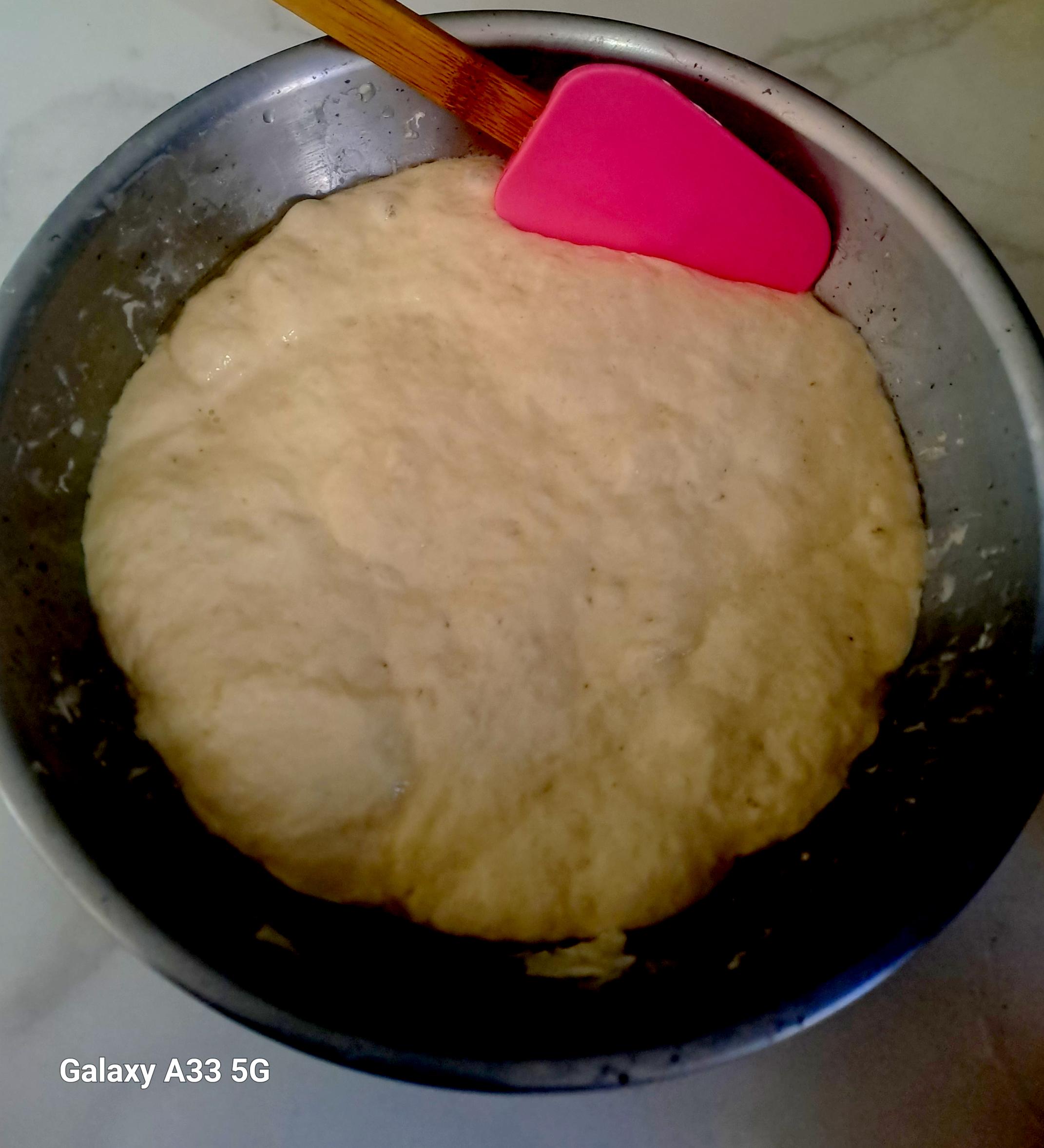
Ready for fridge
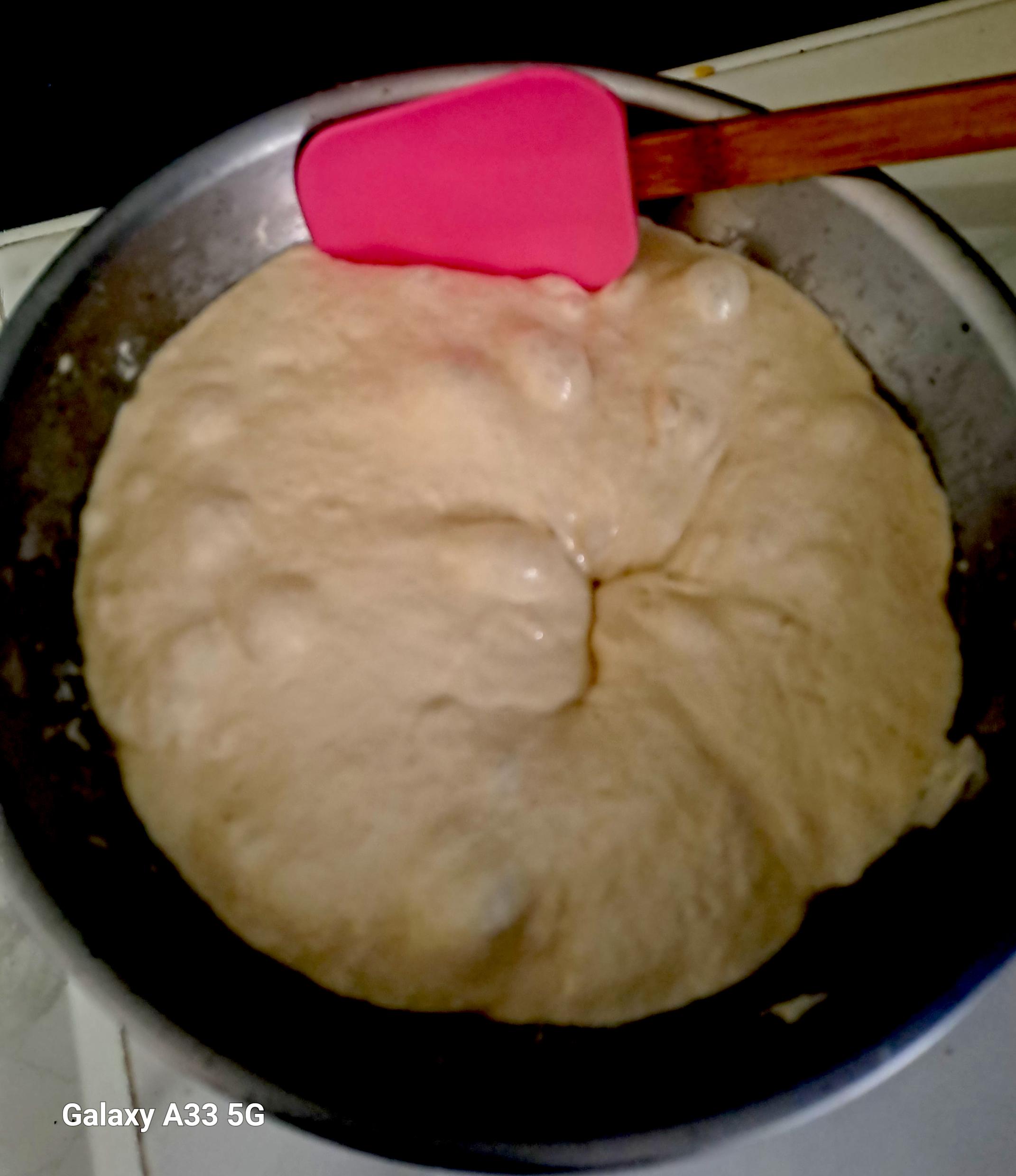
After 24-hours
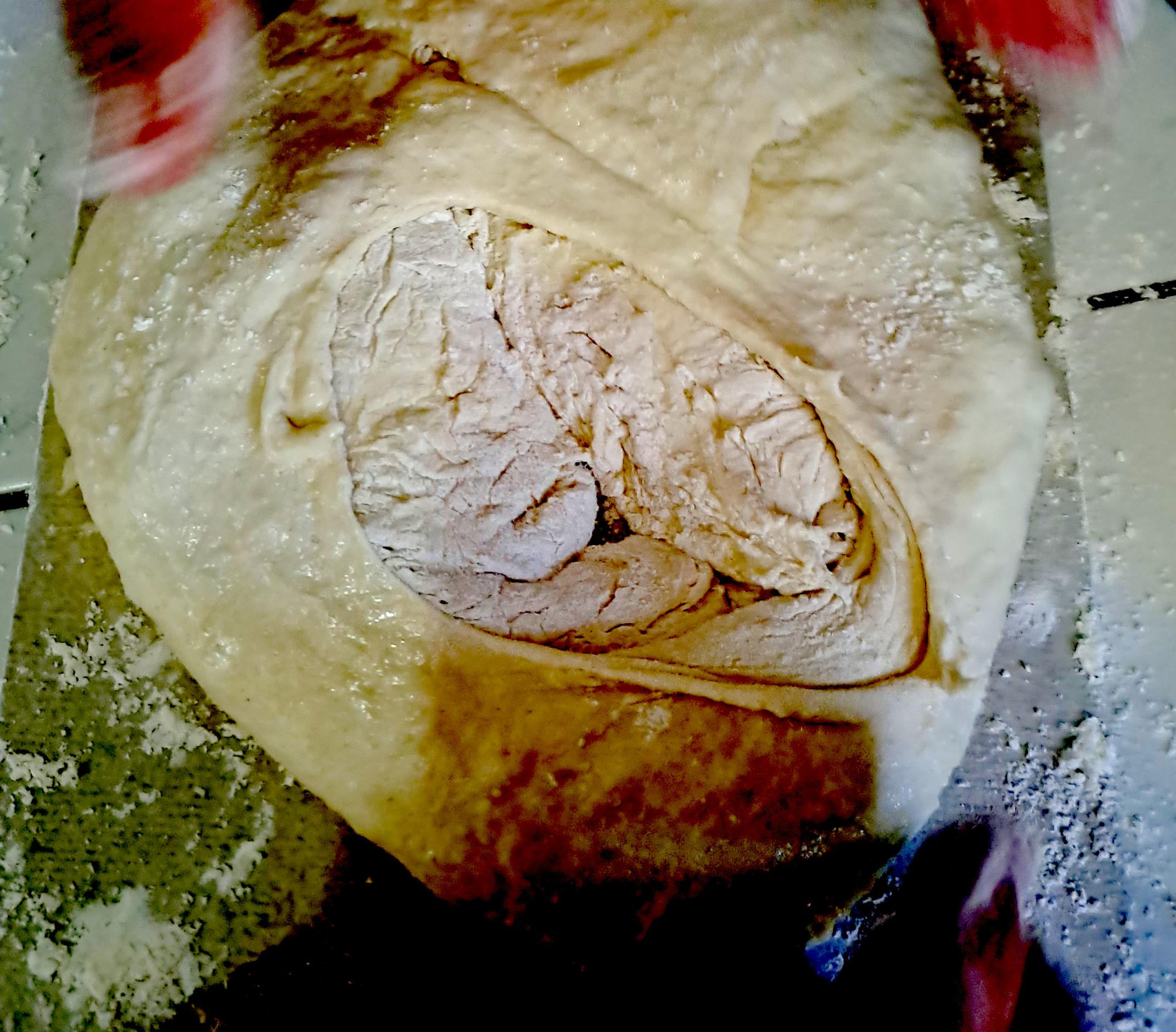
Over proofed
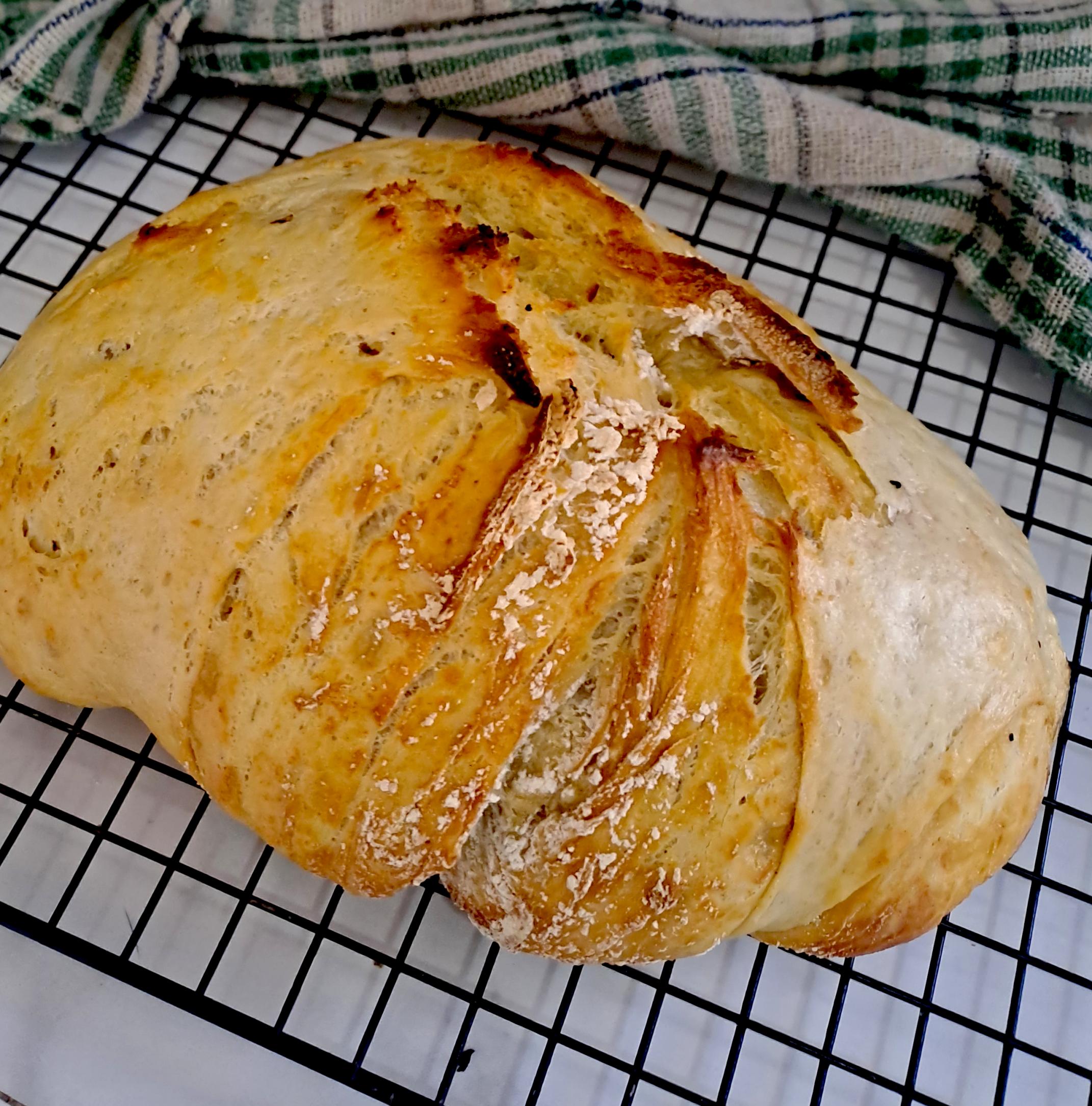
Crust
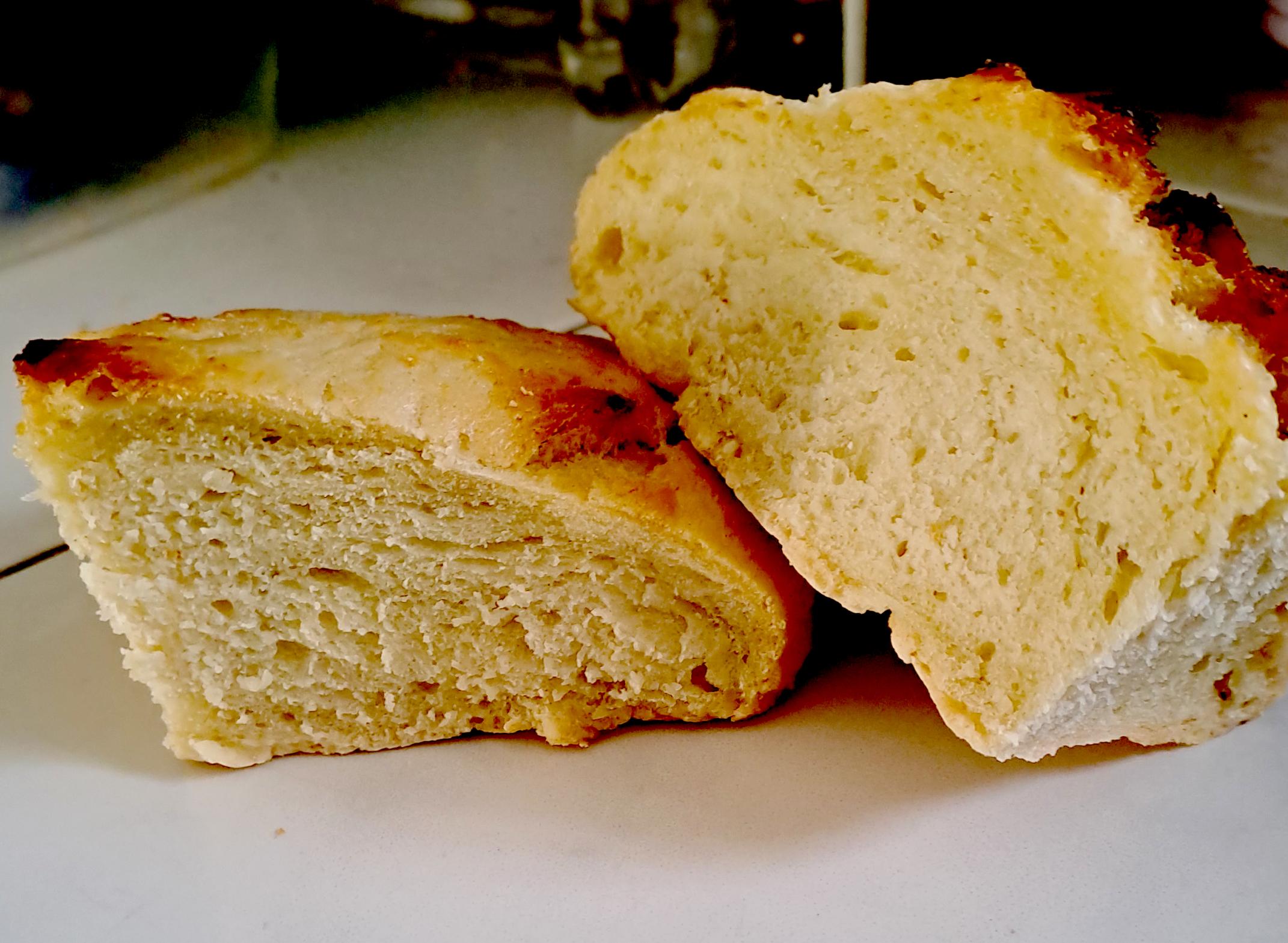
Crumb
NOTES: As expected, the dough was sticky and lacked structure after the 5-min mix. After first Coil-Fold not much development, the dough tore after stretching 6 to 8 inches. After second Coil-Fold there was a small improvement. After third Coil-Fold (see photo), again better but a real cow-pie though the dough was much smoother. After fourth Coil-Fold dough was not much improved and little if any increase in volume. Following 1-1/2 hour fermentation, dough was slack, jiggly and some bubbles had formed on the surface. After 24-hour cold fermentation, dough was jiggly and had continued to rise (see photo), at least doubled in size but over proofed. Comments please...
Katie

Great try, Katie!
I've made Martin Philip's 100% hydration pan de cristal formula many times, with great success. It's a fantastic bread but, yes, it needs higher protein flour. And, also, it doesn't require a cold proof. Nor, it seems, does Solano's recipe that you link to. Pan de cristal takes about 5 hours at room temperature with lots of coil folds. Then you bake it. I cold proofed it once because it was 2 am and the dough still needed a few hours more and I didn't want to stay up all night. Though I salvaged the bread, it was definitely falling into itself when I pulled it from the icebox.
I'm curious what would have happened with your bread if you didn't do the 24-hour cold proof and just baked it as it was after the 1 1/2 hours of fermentation at room temperature.
Rob
Although there was only .23% yeast, a 1-1/2 hr rest followed by 24 hr cold was obviously too much. Solano's dough spent 14 hrs in fridge. I'd say your salt should be halved. It was 11-12g. Next time, I'd lower hydration--heck, bagels are good with 59% hydration, so a good loaf doesn't have to have high hydration. Though 65% is not normally high, with your flour it is.
That being said, how did it taste? Does it make decent toast?
Glad to see you back!
This loaf might not have turned out how you had hoped, but that looks like some major improvement. Great work! Looks like you're headed in the right direction.
Thank you for commenting, Rob. The cold ferment is an effort to provide structure to the dough. My past attempts without the fridge, have left me with a dough that will not roll up into a ball. It just puddles into a pancake in the bottom of my skillet. By refrigerating the dough I can roll it up and get it into the oven before it cow-pies but the result has been a cannon ball. After baking, you need a hacksaw to cut into the crust and the crumb is dense and tasteless.
Katie
thanks, Katie. Here's some thoughts based on nothing but experience & instinct:
and then maybe try baking it after 3 hours in the fridge. Maybe that way it'll be cool enough to shape but not overfermented & slack.
Rob
Thanks for hanging with me, Moe. Surprisingly the loaf tasted pretty good and I could actually cut the crust with a bread knife. And if you look closely, there is the beginning of pockets of air trapped in the crumb. I have been slowly fighting to increase hydration so to reduce it now would be going back to a place I’ve already been. I was pleased to be able to work this dough at 65% so no going back. The over-proofing, if that’s what it was, was a surprise (never had it happen before), so that’s the challenge. And I want your suggestions. Ten minute period of hydration instead of thirty? Twenty minutes between Coil-Folds instead of thirty? Forty-five minute fermentation at room temperature instead of ninety? Would love specifics before my next try.
Katie
Timing of S&F sessions almost never makes any difference. Let enough time go by that the dough had relaxed some (generally 15 or 20 minutes, especially early in bulk fermentation), otherwise do them at your convenience. If your bulk will be long enough, they can even be spaced a few hours apart.
TomP
Thanks for your support, Verdig. It’s been a struggle but yeah, this loaf taught me a lot. I didn’t know whether to laugh or cry when I saw those gaping holes in the dough and it was a close decision between the oven or the garbage bin for that lump of dough. But I baked it and it turned out pretty well and at least, as you said, pointed me in the right direction.
Thanks again, Katie
Rob... Not sure about adding more yeast. Comparing the photos, before and after fermentation at room temperature, I think I have an acceptable rise.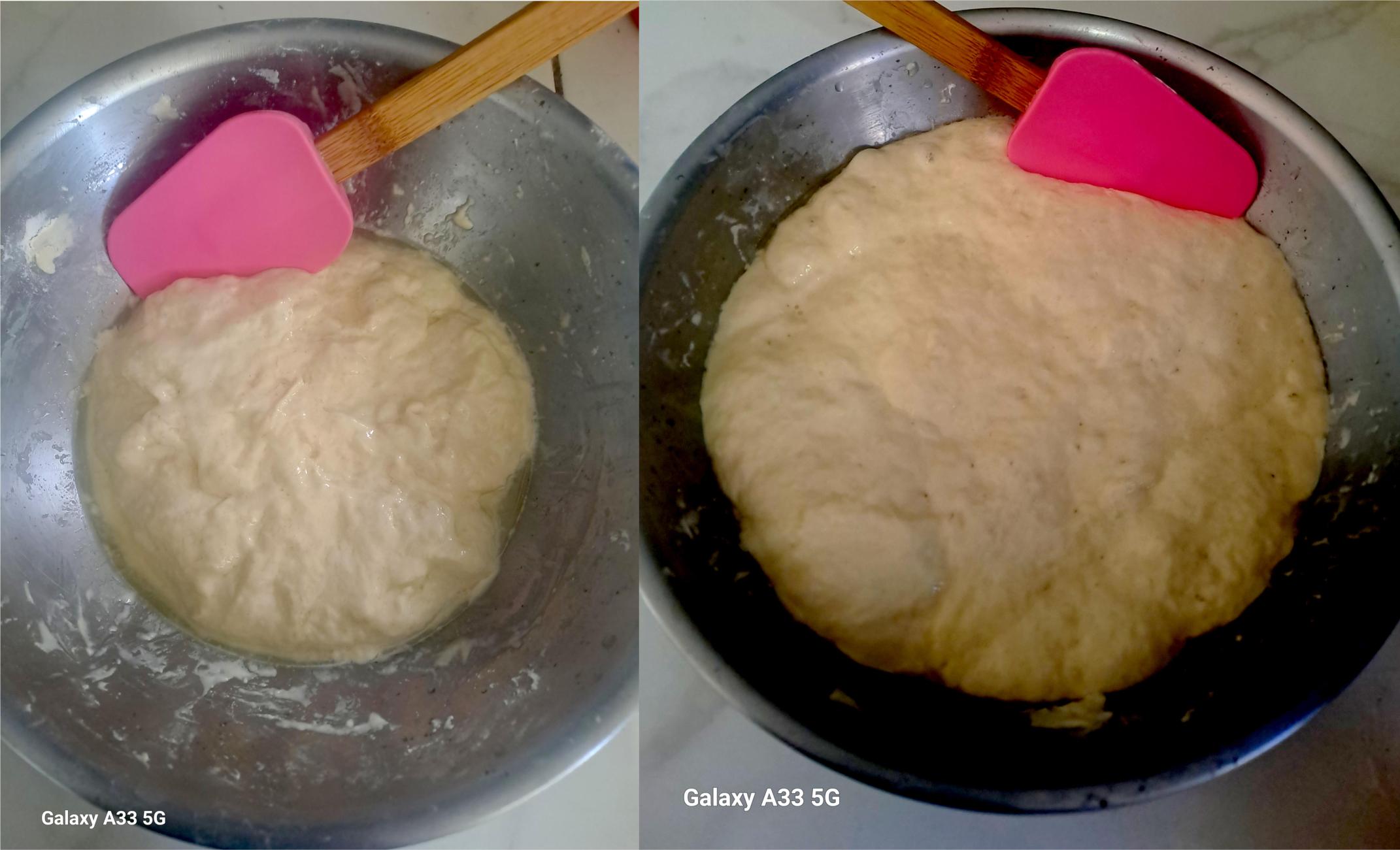
Would adding more yeast firm up the dough? Or are you suggesting that I’ll need more yeast if I cut out the room temperature fermentation and go straight to the fridge.
Katie
The dough in your pictures seems lumpy to me, both before and after rising. Typically for my doughs, after enough S&Fs and enough time in bulk fermentation, the dough looks (and feels) much smoother. For me, this usually happens between 2 and 4 S&F sessions. Sorry, no pics.
Maybe the fast fermentation isn't letting you get to that point. Making the fermentation longer may not work because of the deterioration you've had. That suggests to me that you would do well to make each S&F session longer or more intense. Of course, I'm not there handling your dough so please just consider this idea as a suggestion.
good questions, Katie:
no: more yeast will not firm up your dough. And, yes, you are getting a decent rise in the bowl.
But more yeast will enable things to move quicker. It sounds, from everything you describe, that your major problem is time. According to your schedule, your dough did 3 1/2 hours at room temperature: 2 hours during the coil folds and an hour and a half after that. Doubling the yeast would, I think, give your dough a faster rise. My experience with my fridge is that retarding dough doesn't stop it from fermenting and rising. It simply slows yeast growth and promotes acid development, which adds flavor but tends to degrade dough strength over time. My intuition is that more yeast will speed up lift, allowing for less counter time and a much shorter cold proof.
I have not worked with your flour and so don't know if this will hold true. But that's my thought: more yeast might sacrifice flavor a bit, but it might give you a somewhat more stable loaf in a shorter amount of time.
Rob
Hiya Tom. And yes, I’m thinking maybe a twenty-minute rest between Coil-Folds would be sufficient. I was going strictly by Solano’s findings but the over-proofing took me by surprise. I obviously have to cut back somewhere, the room temperature fermentation I guess. I don’t know...
Katie
...if you are trying to follow Solano's process, cut refridge time from 24 hrs to 14hrs. That's where the overfermenting happened, no?
Yup! It didn’t look like a brain surgeon’s nightmare going into the fridge. I only went with 24-hours because it fit my schedule... make dough at noon... bake at noon... ready for dinner. Who knew that bread could be so touchy :-)
Any thoughts on the 1-1/2 hour fermentation at room temperature?
Thank you, Moe
Katie
Lumpy dough? Yeah... I don’t think I’ve ever had one of those beautiful smooth silky balls of dough that I see others achieve on the YouTube channels, no matter how much kneading, sweet-talking and cajoling I do. What you see in my bowl is what I always get.
Katie
"Any thoughts on the 1-1/2 hour fermentation at room temperature?"
I went back to Solano's method to see what he did. It appears that after the S&Fs, the dough went directly into the fridge for 14hrs, then preshaped, rested 20min, then shaped. THEN, one loaf sat for 3hrs and the other for 4.
You could try that order of operation, just to see if the dough rises after it warms and doesn't turn into a puddle. I dunno, I just dunno.
Thanks Moe. Going on past experience with this flour, letting the dough warm to room temperature after cold fermentation leads to a cow-pie that has no structure and can’t be shaped. I’ve toyed with the idea of sticking the dough in the freezer for a couple of hours following cold fermentation to help hold things together.
My gut feeling is that cold dough going directly into a 500F oven causes the crust to form quick and hard, retarding oven spring and resulting in the previously mentioned “canon ball.”
Yeah... I dunno either...
Katie
That 14-hour cold ferment is going to be a pain. It means mixing dough late in the day. That’s “Bad-Eye” Bolo’s time when we walk down to the fishing boats then stroll back through the village to visit with neighbors.
Okay. Bolo’s a good sport and we’ll manage.
Here’s what I’m proposing for another try: The bread recipe stays basically the same except for halving the salt and doubling up on the yeast, to 1/2 teaspoon. I’ll let the dough hydrate after mixing for 15-min and rest for 20-min between Coil-Fold sessions. Then cut my bulk ferment back to 1-hour, or until I feel the volume of dough has doubled. Then into the fridge for 14-hours.
Anyone see any glaring errors in this approach?
And thank you everyone, for your time and support.
Katie
Hi Katie,
I think you've gotten many great suggestions above! So, just to make sure I've understood everything:
I feel that it might be worth finding out how the bread turns out if it actually gets to proof. Is it at all a possibility to first try baking the bread in a tin/pot? It might be worth experimenting with this first without cold bulk, simply because it adds yet another unknown into the equation (how much yeast for what fridge temperature for what duration). This means doing what you've done above, but instead of putting the doubled dough into the fridge for bulk, you pour it into the tin and let it rise till 1.5X (you might need to find out how far you can stretch this over subsequent bakes) and then bake it.
If baking in a tin is difficult, then I'm just wondering if there's a way to let the dough proof after bulk ferment without puddling. If you prefer to stick to 24 hours, perhaps:
Good luck and update us.
-Lin
Yes Lin, and thank you. Everyone has been so very generous with their time and support, so much so that it amazes me.
You seem to understand my problem: weak flour... one that could be called pastry flour... that at low hydration results in a round loaf that has a dense, tasteless crumb and a hard-to-cut and chew crust. Slowly increasing the hydration, testing loaf by loaf, I find the taste and texture improves but the dough lacks structure and cow-pies. Getting the dough good and cold helps... getting it from the fridge, shaped and into the oven before it knows what’s happened :-) But I still have not achieved that nice airy crumb.
I’m a little confused by your suggestion to decrease the amount of yeast when it was suggested I increase the amount. And also your use of the term “proof.” I bulk ferment at room temperature then cold ferment. What do you mean by “final proof?” I thought I had all the bases covered. Anyway, no tin at present. I guess I could cut a juice can or something or look around the next time I travel to the city.
Anyway, the next lump of dough is currently in the fridge. I cut back on fermentation time to avoid over-proofing, as outlined in my previous post and will attempt to shape and bake tomorrow morning. I’ll post the results with a few photos. The dough was very slack going into the fridge so I’m not expecting miracles but we’ll find out in 14-hours.
Thanks again for your suggestions.
Katie
Suggestions to increase yeast are based on the idea that reducing fermentation time might help you avoid the collapse. In suggestions to reduce the yeast, I think, the idea is to allow for a longer cold ferment without excessive fermentation.
I think that the collapse is mainly caused by time, not the amount of fermentation. If so, more yeast should be better. But I could be wrong and you will only know by trying.
I have a bag of stone-ground whole wheat pastry flour, and after you posted I tried making bread out of it. I was able to get something usable but it wasn't very good in crumb, crust, or strength. Using it 50%-50% with a better flour worked well enough but I know you can't get any.
TomP
I thought of trying to duplicate conditions, too, but I've got no pastry flour and I thought I'd have to crank the furnace up to 75.😊
Thanks Tom. So less fermentation, more yeast. Makes sense. I guess you wouldn’t hazard a guess as to how much yeast?
Anyway I’ve reduced fermentation time: hydration down to 15-min from 30; rest period between Coil-Folds down to 20-min from 30; fermentation at room temperature down to 1-hour from 1-1/2 hours; and cold fermentation down to 14-hours from 24-hours.
I thought “time” was my friend when developing glutton. The whole process is confusing and very frustrating but the oven is currently pre-heating to 500F so we’ll soon find out. More later...
Katie
Hi Katie,
Apologies if my response left you even more confused! I have not checked exact terminology as used by the pros, but I have always understood it like this: Bulk fermentation begins when everything is mixed into a dough and until the dough is shaped to be baked. Proofing happens after the dough is shaped to be baked, left to ferment further (1.5 or 2X size), and ends when that shaped dough is loaded into the oven.
Because you mention that the dough is shaped after it's been in the fridge (and collapses somewhat when you shape it), and then almost immediately loaded into the oven before it puddles, I had the impression that your dough doesn't actually go through proofing. To my mind, this means it won't have much of an airy crumb. Of course, there are breads that are shaped and immediately loaded into the oven, but these breads tend to have pretty strong gluten structure.
Re proofing in a tin: If you have a pot or some sort of vessel that can go into the oven, it might be worth trying.
I suggested yeast reduction if you prefer to stick to 24 hours of cold ferment for scheduling reasons. Since there was overfermentation for that amount of yeast and that amount of time, then the logical thing to do there is to reduce the amount of yeast for the same duration. The alternative - the way I see it anyway - is to use the same amount of yeast, but reduce fermentation times. Perhaps I'm a bit old-fashioned to just change one variable at a time!
Fermentation does develop gluten passively, but when it goes too far then the acid breaks down the gluten network, which results in soupy dough. Gluten can also be developed actively, i.e. mechanically, through kneading, slapping, vigorous folding etc. So what you've done so far, in combining both the folds and the cold ferment, is absolutely on the right track, but - to my mind - what we need to find out now is 1) when to arrest bulk fermentation, and 2) ideally if some sort of proofing can happen after the dough is shaped.
But I hope this new loaf today might bring us new insights - please update us :)
Time is your friend when developing gluten but the flour has to be able to hold up during that time. Yours doesn't seem to, so you've got an exception. The alternative is to try to develop more gluten at the start. Too bad your flour doesn't seem to have much to give.
Time is good for gluten up to the point where it isn't. Then breakdown/degradation starts.
Rob
5. There's also the cheater method: someone you know (one of us here?) could send you a small bag of vital wheat gluten. You'd just add a tiny bit to your mix and, like magic, you'd have strong flour.🤣🤣🤣🤣🤣🤣
Katie, you might have to put up with crappy flour, but you don't have to put up with this.
What a sloppy mess. Worse than the over-proofed dough before. If you can shape and score this dough, you deserve to be a celebrity baker with your own YouTube channel. But the bread surprised me...
Let’s start with yesterday:
The forth Coil-Fold session (20-min rest between sessions)
Dough after 1-hour room temperature fermentation
Dough coming out of the fridge this morning, after 14-hours
The slop
The crust
The crumb
There was no way I could shape or score the dough. It was like a bowl of porridge. I basically shoveled it into the hot skillet, poked it into shape and hoped for the best. Bake was at 480F, 20-min covered, 20-min uncovered. I got a reasonable oven spring and the bread scored itself, luckily. The crust wasn’t crispy-crunchy but wasn’t like cutting glass either. And the crumb was soft and chewy and, for the first time, I saw the beginnings of an airiness. The taste wouldn’t win a ribbon at the fair but was pretty tasty.
So room for improvement but still, a surprise.
Katie
that looks like bread!👍🏼✊👌
You know, it looks bad in some ways but the baked loaf also looks like bread. If you have one, the next time you get dough like this, pour it into a loaf pan and bake it that way. You will probably end up with a decent-tasting loaf even if it isn't a hearth loaf.
Also try reducing the hydration by a few percentage points next time, see if that works a little better. Remember, with this flour there might be a definite threshold for hydration, and if you can get under it yet have enough water, you might get better results.
Lin, no apologies necessary. I couldn’t quite grasp the distinction between cold fermentation and cold proofing. Putting the dough back in the fridge after 14-hours didn’t make sense to me but now I get it... that’s when the dough “gasses-up” inside, after shaping. Anyway, as you can see in the photo above, not much shaping happening here.
And I’m not sure I like all this curling and folding. Solano (from Brazil), seemed to have a handle on 3rd world flour with his gentle approach so I needed to try it myself. But it seems kind of “girlie” to me. I like to smack my dough around. Slam it down and beat it into submission. I like to get physical. Nothing like a 10-min tussle with the gooey stuff to leave you feeling exhilarated. No mixer for me, no sir.
So maybe I need to go straight to the fridge after the final session of coils. And a few minutes in the freezer to stiffen things up? There’s so many variables you could end up experimenting forever. I guess some on the forum like that. I just want a rustic loaf of bread.
Katie
I like how you describe your treatment of the dough, Katie. Lots of upfront rough treatment definitely mechanically develops the gluten. But I'm not sure you can do much tugging and slamming with the very gooey dough you have at the moment.
At this point I feel that this gooey, weak dough that can't really support its own shape just won't give you the rustic loaf you're looking for. I feel that if you bake this dough in a tin/pot (letting it proof after shaping) it might well work out, but I don't know if you'll like a bread that takes the shape of its container.
If you're really after a freeform loaf, then I feel that dropping the hydration just a wee bit might be worth trying. Then you can work the dough more too. Perhaps even refrigeration in between folds and stretches to keep it manageable. And if you manage to get it into something shapeable to let it proof in a floured vessel in the fridge, to bake directly in the oven the next day, all the better.
And yes, the proofing is for the final "gassing up", if not you're really just baking somewhat dense, deflated dough. Bulk fermentation serves the purpose of developing gluten strength and flavour and creating air bubbles, and the latter would be mostly lost if the cold fermented dough is deflated and baked almost directly.
Tom & I keep saying cut back on the water. You say the lower hydration bread was a hard block; however, that loaf did not go through the process you are now trying: stretch & folds and cold fermentation. The dough doesn't have to be so dry as to be crumbly, but less water should make it shapeable. The thing is, you can always add more water during the process--there's even a name for it, bassinage.
This loaf looks pretty good. Don't give up.
Bolo is an old street dog who adopted me. He noses his way into my apartment shortly after six each morning, flops down in a corner and falls asleep; for the entire day. Lord knows what he’s up to at night. He’s bow-legged in back, half his tail is missing, one ear is up and the other down with chunks missing outta both, and he’s buggered-up his right eye.
Waiting for the bread to rise. Eat your heart out, Moe.
👍
Dogs are the best -- and they know a good thing when they find it. Congrats to you for letting Bolo do his thing! --Rob
Rob, you shouldn’t be waking up in the middle of the night thinking of cold water. But being you have, do you mean ice-water? Lin even suggests refrigerating the dough between the Coil Fold sessions. And I was thinking of the freezer for a short blast just before shaping. Anything to stiffen-up the dough.
Katie
Let's not throw cold water on my cold water idea just because it came in the middle of the night!🤣🤣🤣
You could use refrigerated water or ice water (though you should probably strain out the cubes). This would not tighten up the dough, but rather would slow fermentation at the start, which should mean that it will be less likely to overferment later on.
Rob
Yeah, Lin, I’d love to work that dough but Tom can tell you from past experience that aggressive kneading would make things worse. And it’s getting away from Solano’s method with weak flour. I was so hoping to achieve the 68% hydration he ended up with. Of coarse his weak flour is 10% protein, mine is 9.4%. I guess that’s a big difference.
So this last attempt wasn’t the rustic boule I was after. And yeah, that might be a pipe dream, but I’ve met some nice folks while trying.
Katie
There seems to be a general consensus, thank you everyone, that I need to cut back on the hydration. Is a 5-gram reduction a reasonable place to start? Remember, my loaves are small... 320-grams of flour.
Katie
5g might be a good start. Alternatively, you could begin with the same amount of water and flour you've been using, and just add flour bit by bit to see how far you can push it without the dough seizing up.
I would try a reduction of 2 points (baker's percentage). For 320g of flour, that would be a reduction of 0.02 * 320 = 6.4g, so 5g was a good guess. If your flour behaves as mine did - we can't know without trying - it ought to behave better but maybe only a little. If so, reduce again by the same amount. Again, with your flour the dough may get too dry before you can reach a point of real improvement.
I had a completely different idea to try. If you can't buy "vital wheat gluten", you might try making your own gluten booster by washing the starch out of some dough. This will leave you with a hard rubbery mass of gluten. Let that dry, and grind it into powder - of course, you have to be able to grind it somehow, maybe with a mortar and pestle. Add it to the next batch of flour you make. You can find out more about extracting the gluten on line.
Thanks everyone. I think this thread is long enough and I need to try some of the ideas that you’ve presented. Let me think of my next step a few days and then start a new thread. Thanks again, you’ve all be so very kind. Be back soon...
Katie