
Hello,
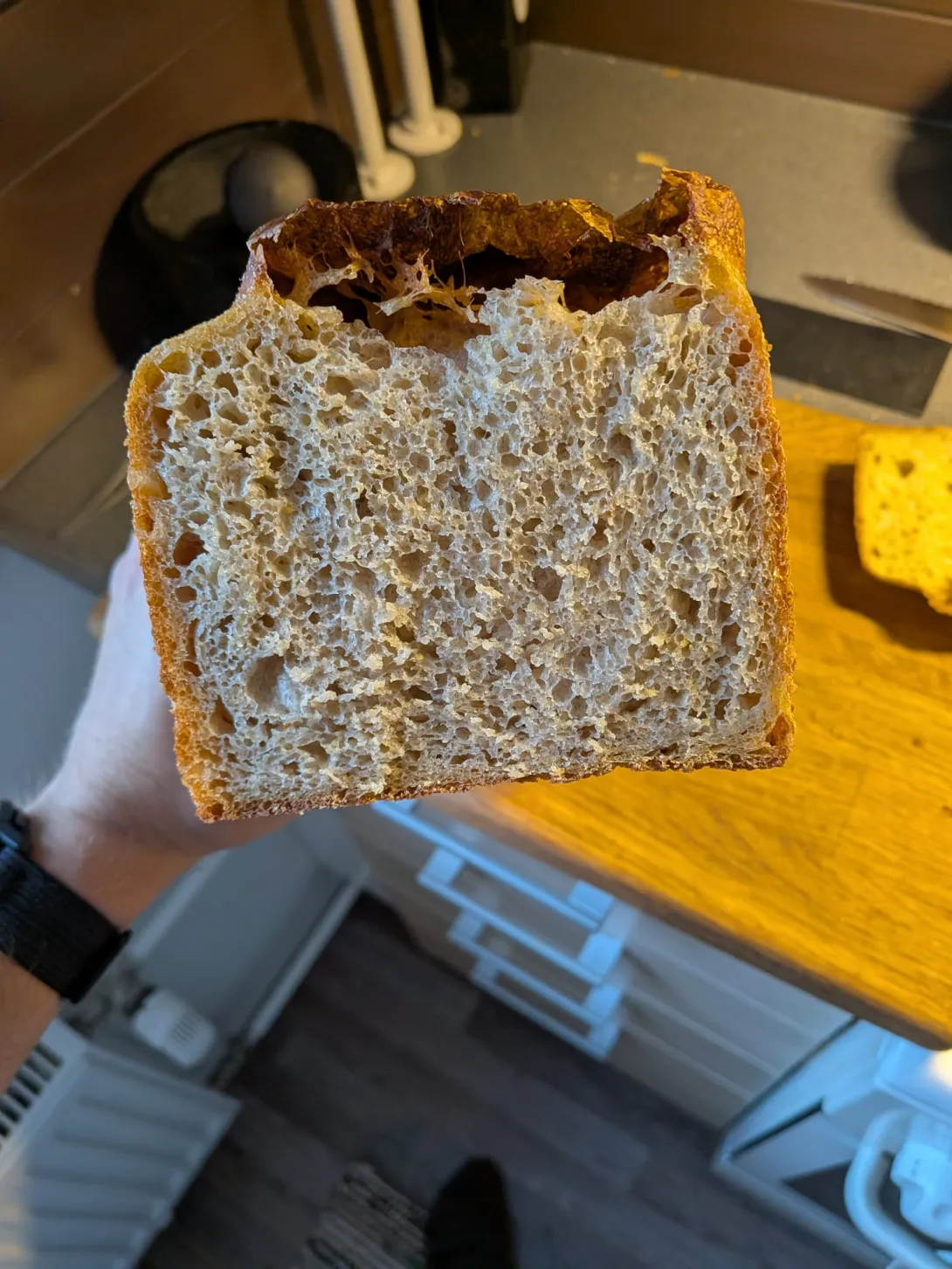
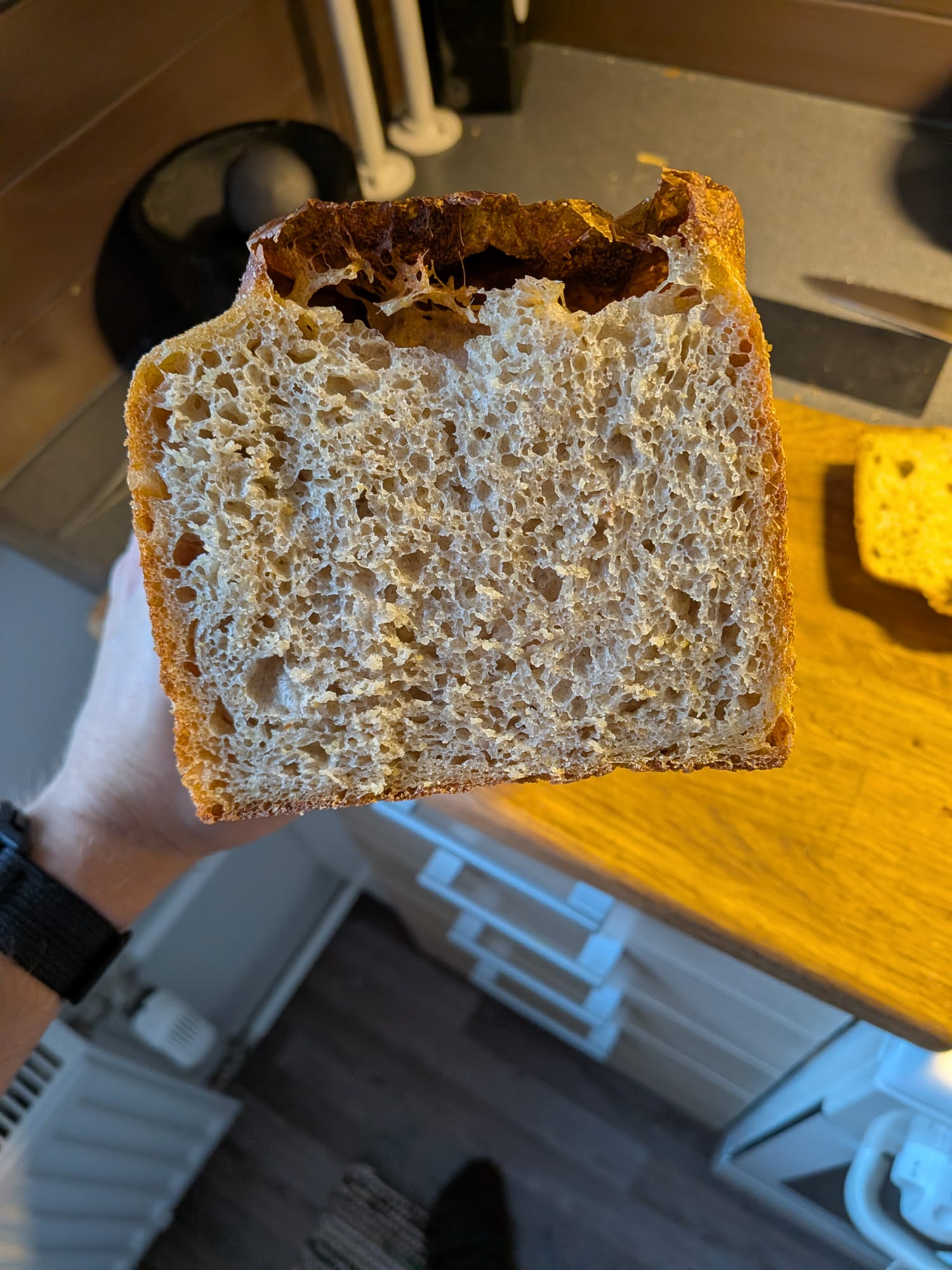
I have run into issue with my sourdough pullman loafs. For unknown reason there is air pocket on the top of the loaf which then forms this thin skin during the bake and separates. However, before putting the loaf into the oven there are no visible bubles or air pockets on the surface.
Could this be a timing issue (bulk or proof), shaping or dough strength, baking or too much dough for the tin?
This dough was:
70 % hydration
mostly all-purpose flour with some whole wheat (approx. 15 %)
2 % salt
2 % sugar
20% starter
This loaf I bulk fermented for 5 hours (approx 50 - 75 % increase in volume), shaped, proof 1 h on the counter and 20 h in fridge. Baked cold from the fridge in 200 C for 50 min (lid on), cool 10 min in the tin (lid off) and rest of the cooling down on wire rack.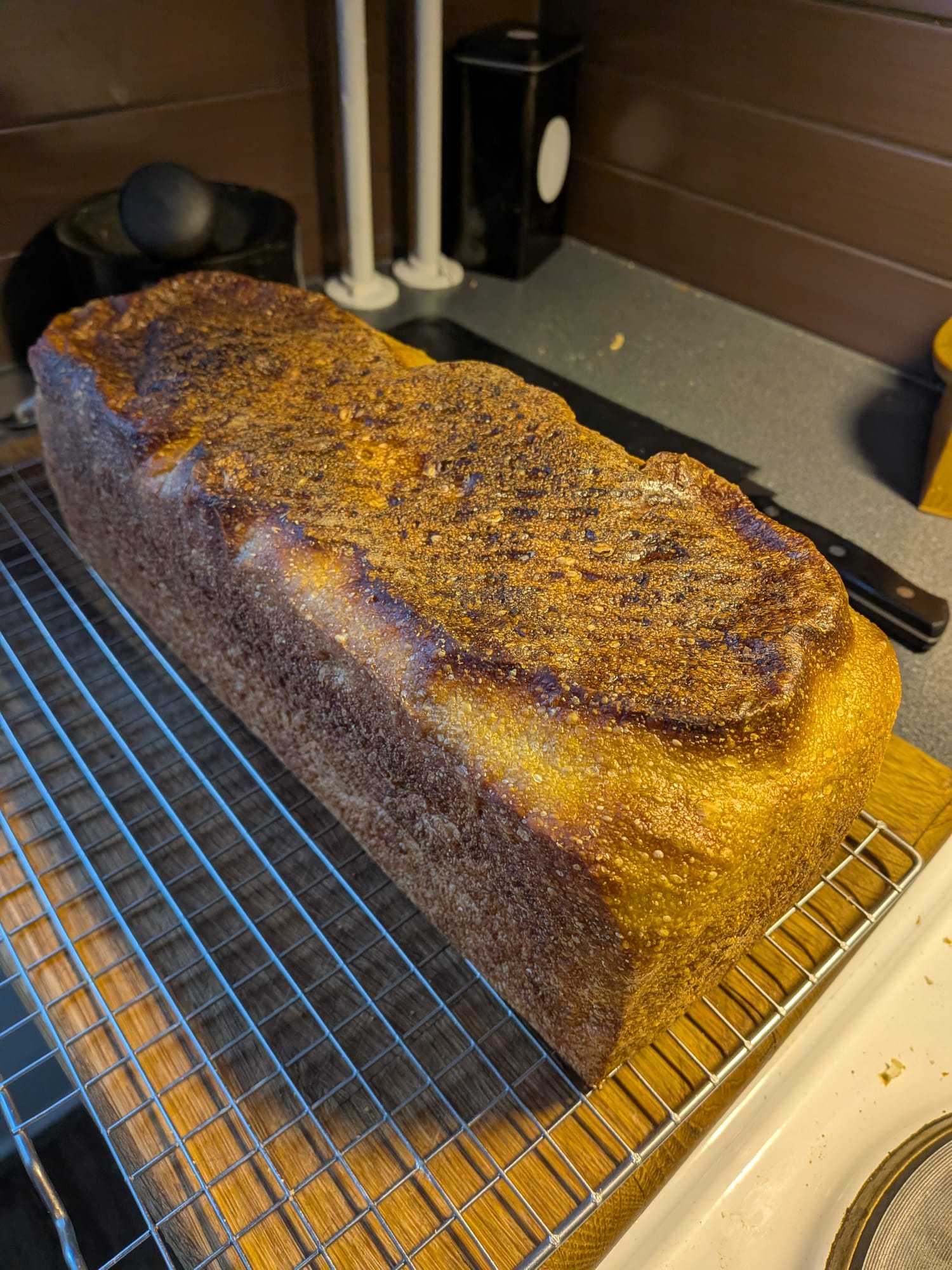
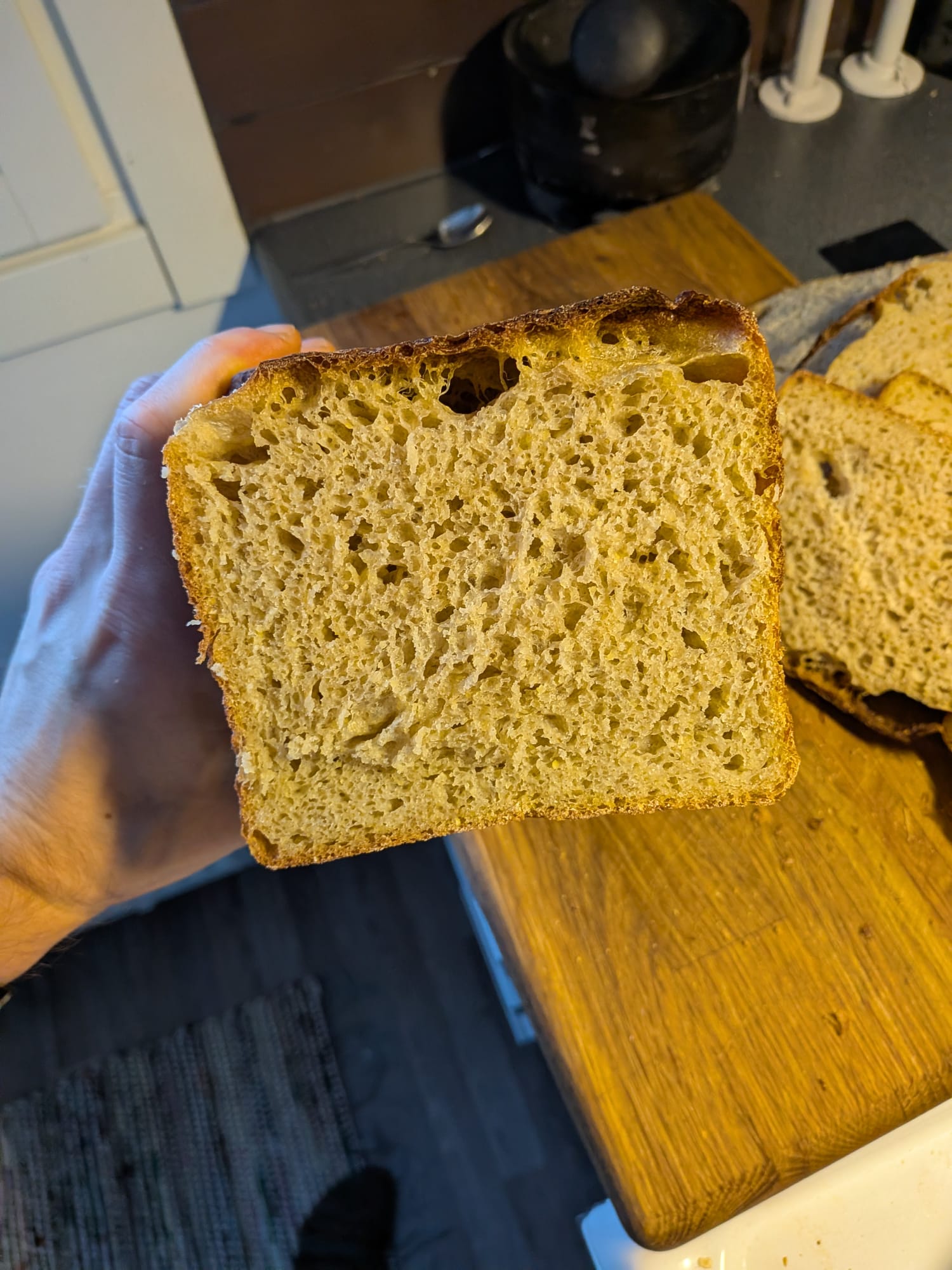
Try degassing the loaf more thoroughly before shaping. The dough should not have many if any large bubbles at that point. Second to that, let it rise more before shaping. It doesn't look to me like there is too much dough, and even if there had been it wouldn't automatically lead to air bubbles like that.
TomP
I think I will try to push the bulk a bit more before shaping and maybe cut the proof on the counter so that the total time will be similar.
It's a pity that this aspect of bulk and proof timing is not discussed in the recipes or guides. Oh well, you live and learn... I guess that is what keeps me hooked on sourdough baking.
Thanks for the tip
Especially with Pullman loaves, timing is not usually critical, not at all. As an illustration, I recently left the dough in its bulk fermentation tub out all night when I had planned to refrigerate it. The dough had risen by about a factor of four. I was able to ease out the dough without tearing it, and gently got it into the pan. This bread came out very well.
With a Pullman, if the dough proofs too long in the pan, I mean really too long, it might even deflate a little during baking, yet the result will still be a good loaf of bread.
So yes, by all means let the dough ferment longer.
TomP
I think it might have spent too much time proofing. I used to have these holes. They disappeared when I pushed bulk to really develop strength, and not overdo the proofing.
Just to say I really don't think this is an oven spring issue or a dough volume issue. If you've ruled out shaping issues - shape rather tight and limit use of flour - then my best guess would be to reduce proof.
Do you let it rise the last little bit with the lid on?
Could be that it's not risen enough before it goes into the oven, and that's the "spring".
I've gotten large bubbles at the top both lid on and lid off. So I don't think the lid being one way or the other would make much difference in preventing these tunnels.
Tunnels, also known as mouse holes, are common in very high hydration breads like ciabatta and glass bread. The standard way to prevent them is to turn the loaves upside down just before baking. This can be tricky since those loaves tend to be delicate and hard to handle. I've never convinced myself that turning a Pullman loaf upside down before baking would be a good idea....
I’ve baked a lot of Pullman loaves. In my 13” I use 1400 g of mixed grains. The more white flour the less weight needs to be in the pan to fill it.
1) Do the bulk rise in a well buttered Pullman. There is no reason for a separate bulk and then shaping. I do it all the time this way.
2) leave the cover off while dough is rising in the pan, I use a “ shower cap” stretchy so I can see the loaf.
3) let it rise AT ROOM TEMP til it’s 1/2-1” from top of pan. Place well buttered lid on pan refrigerate and DO NOT move lid again .
Preheat oven 375°. Place covered ( please don’t move lid) cold from fridge into oven. Bake for 25 min lid on . Remove lid bake 20 min. Remove from pan and cool.
The only time I’ve had errors they were of my making. Removing lid to peek before bake , over filling ( this actually is ok because the dough comes out and you break it off tastes like breadsticks!) failure to butter lid etc.
Bulk rise plus shaped rise truly isn’t needed. A well developed dough using folds and a couple laminations is all that’s needed.
Try again and good luck.
This suggestion illustrates how tolerant baking with a Pullman pan can be. I have also bulked right in the pan and had successes. Currently I do bulk fermentation separately, because I hope that stretching the dough at that point will strengthen it for the proof and give me a chance to degas the dough. Stretching will also reset the rate of rise for the proof (or at least the first part of the proof) if it has slowed.
But I don't know for a fact that those ideas actually make much difference in practice, and they certainly aren't needed. If you end up with a very wet dough, so wet or sticky that you can't really handle it for shaping, then you will be better off just doing one fermentation in the loaf pan (don't forget a few S&F sessions first). This can feel very freeing because you don't have to worry about over-hydrating or even hitting some exact amount of hydration. It will all work.
Things I changed:
Things I try next time: