
Saturday morning was around -9F (-23C) where I was this past weekend and I was trying to bake a rye. The kitchen was reasonably comfortable -- around 70F (21C). But the dough wouldn't respond. I baked 2 suspiciously biscuity breads before I realized that, when outdoor temperatures get this low, humidity naturally dives toward the single digits, and objects don't hold heat well even if the indoor air is relatively warm. For the 3rd loaf, I used a much higher inoculation for the preferment (30% instead of 8%) and let the final dough go for 8 hours on the counter instead of 3. Also, total hydration needed to be higher than usual -- somewhere around 85%. And this was the beast I pulled from the oven. Sorry no crumb shot: I gave the boule to a friend.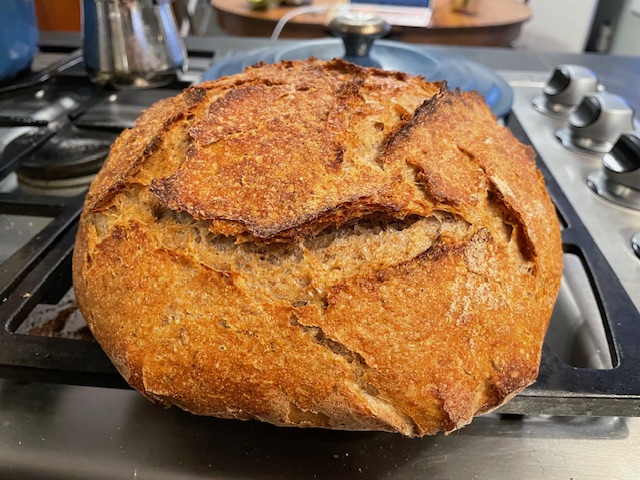
Rob
That's really interesting. I was not aware that the outside temperature had such an impact on humidity levels indoors. Good that you realized what was happening and made those adjustments with the inoculation %, hydration and counter time. Perhaps it might work to let it rise in a somewhat warmer place like an oven preheated for a minute?
The loaf looks very Rob-ish as usual and it would be interesting to know how the taste/texture changed as a result of this.
Also. I could never manage those temperatures outdoors, I don't think.
After the super-dryness of a few weeks ago, which meant that I had to greatly lengthen fermentation times, it's been super-humid in New York. When the weather was 0F/-17C, the relative humidity was 17% in my apartment. Last night, with the temperature at maybe 40F/4C, indoor humidity was close to 40%. This change definitely impacted how dough internalizes temperature.
Last night, making the same deli rye, even at 8% inoculation, it became clear that the levain had softened more than usual. The final dough was warm and slinky in my hands. I could feel it gather some strength after 12 minutes of kneading only to lose its form if I gave it any rest. And I noticed the outside was starting to look a little rough.
Though it usually takes 2 hours of bulk fermentation and an hour of proofing, I had an intuition that I had to bake this bread after just an hour on the counter. So I hurriedly shaped it and threw the oven on, mistakenly leaving it on the highest setting -- broil -- which is above 550F/287C (note to self: don't do this again. I discovered later that I spot-melted the part-polyester cloth I was using to handle my dutch oven. It was only blind luck that it didn't melt on me.)
I dodged injury and got a nice bread in the bargain.
--Rob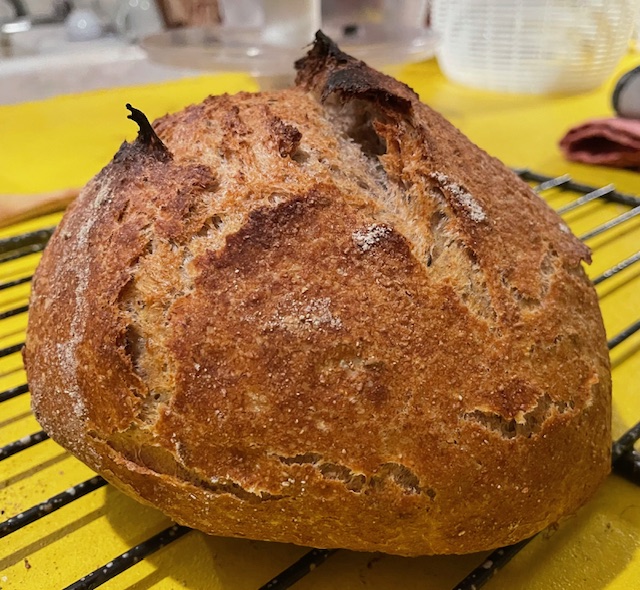
Love those ears! I've accidentally broiled a few loaves myself, I know how that goes.
TomP
Thx, TomP -- given the ears on this sucker, I might just stick with this broiling the bread idea -- though definitely with 100% cotton towels. 🤣 Rob
We have a 7’ 6” grand so humidity is a constant issue in our home. Perhaps that’s why I’ve never noticed any change in my breads due to humidity levels in the house with respect to the outdoors.
We have 4 large and 1 small humidifier going throughout the Winter months as soon as the radiators are in use. Summer isn’t usually an issue as we don’t keep the a/c very cool.
I’ve never noted such a difference in bread dough response as you’ve experienced . I am sure glad! c
a concert grand -- cool!
I only noticed the humidity thing because I was at my brother's house and, at -10F/-23C outside, he was running a humidifier in the living room next to his new classical guitar. I walked by and realized it was noticeably warmer-feeling around the guitar than in the kitchen, though both rooms were the same temperature. My new theory is that, when humidity gets super-low, items like dough (and guitars and pianos) have a hard time holding heat.
Rob
The mouse is a joke… our daughter’s nickname . My husband said it’s a 7’2”🤷. This one of the 3 big humidifiers