
Making the biga was straight forward using Rene’s instructions: 160-flour; 72-water; 1/4-tsp active yeast. Hydration of 45%. A rough mix and into the fridge for 24-hrs.
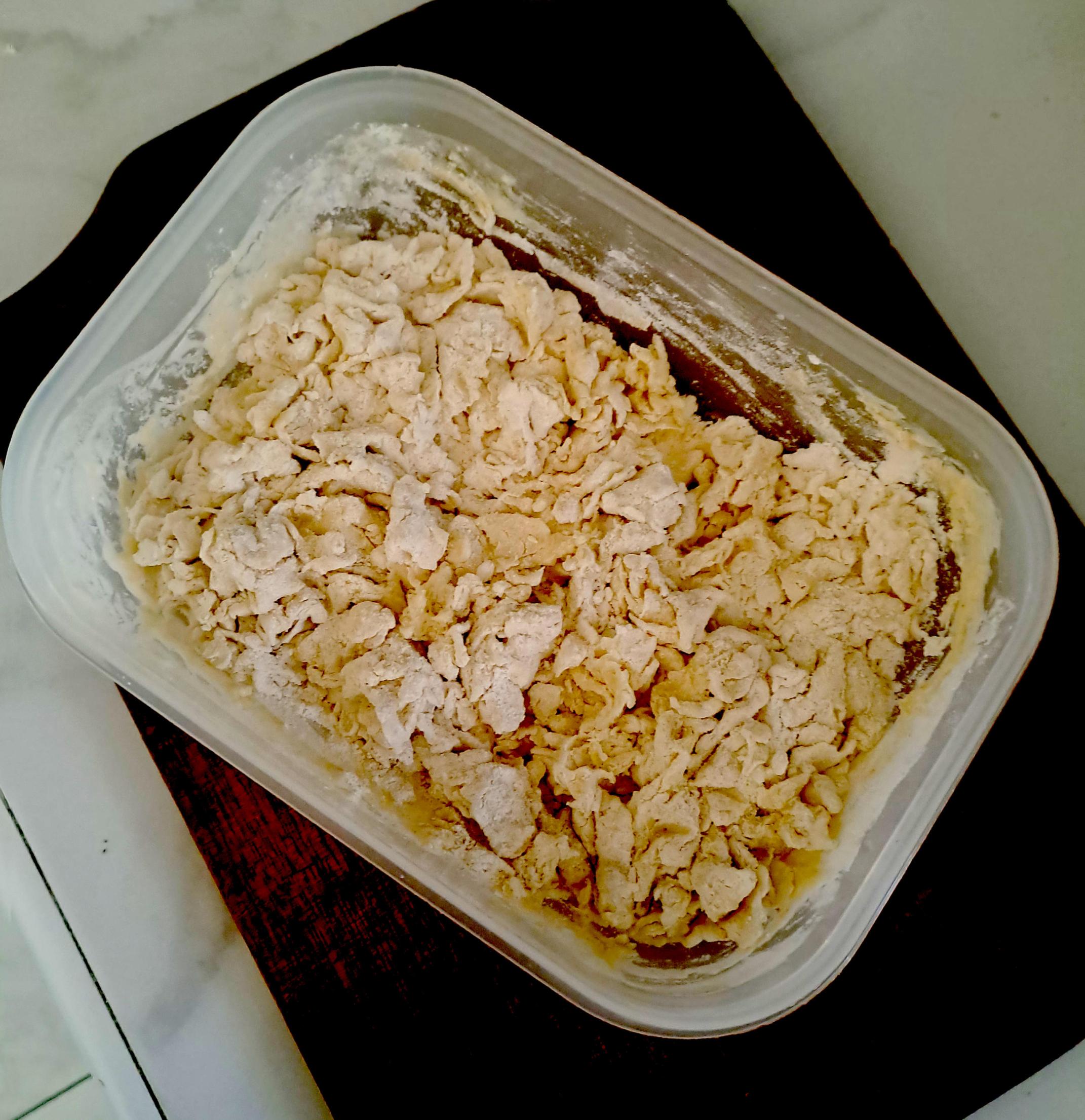
Biga ready for the fridge
Next day, 143-gr of water with 1-tsp of salt went into the fridge along with a separate bowl of 160-grams of flour. Both were chilled thoroughly.
I used a spatula to turn the cold biga out of the tuperware and into the cold water in the mixing bowl. It went back into the fridge for a 30-min soak. Combining the biga and water took about five minutes and it was hard to remove the lumps of biga with a spatula. I might try a potato masher next time. I finally gave up and, ignoring the pea-sized lumps, mixed in the additional 160-gr of cold flour and folded the dough for 4-min to be sure all the flour was incorporated. As per my recipe, I let the dough hydrate for 10-min.
The dough seemed softer and stickier than my previous attempt without biga. The folds, coils and stretches were a little easier but I was still jiggling the dough to make it stretch down from my fingers. I allowed a 20-min rest between Coil-Fold sessions.
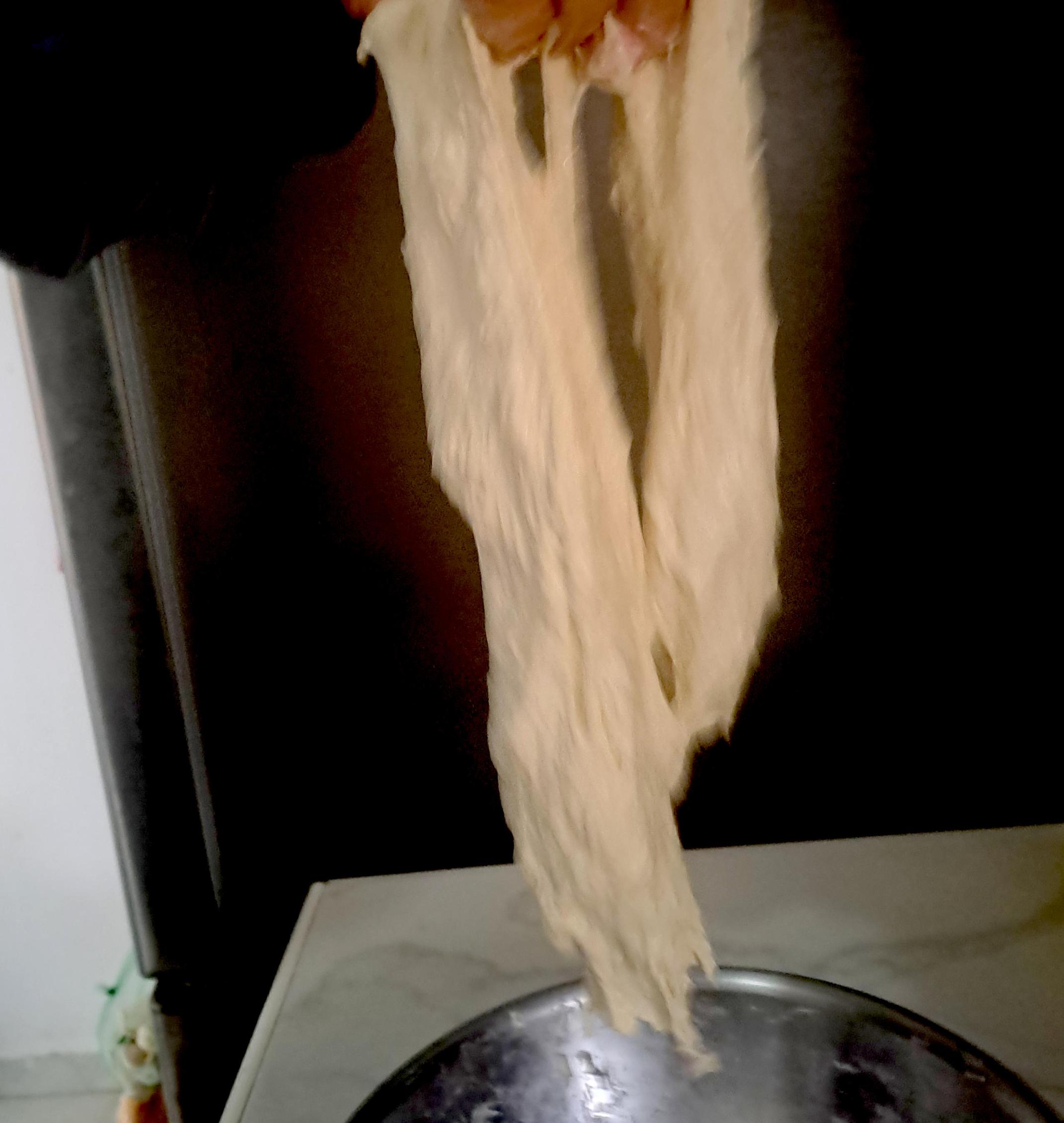
The forth Coil-Fold
So far, no surprises. I placed the dough, along with a control sample, into the fridge.
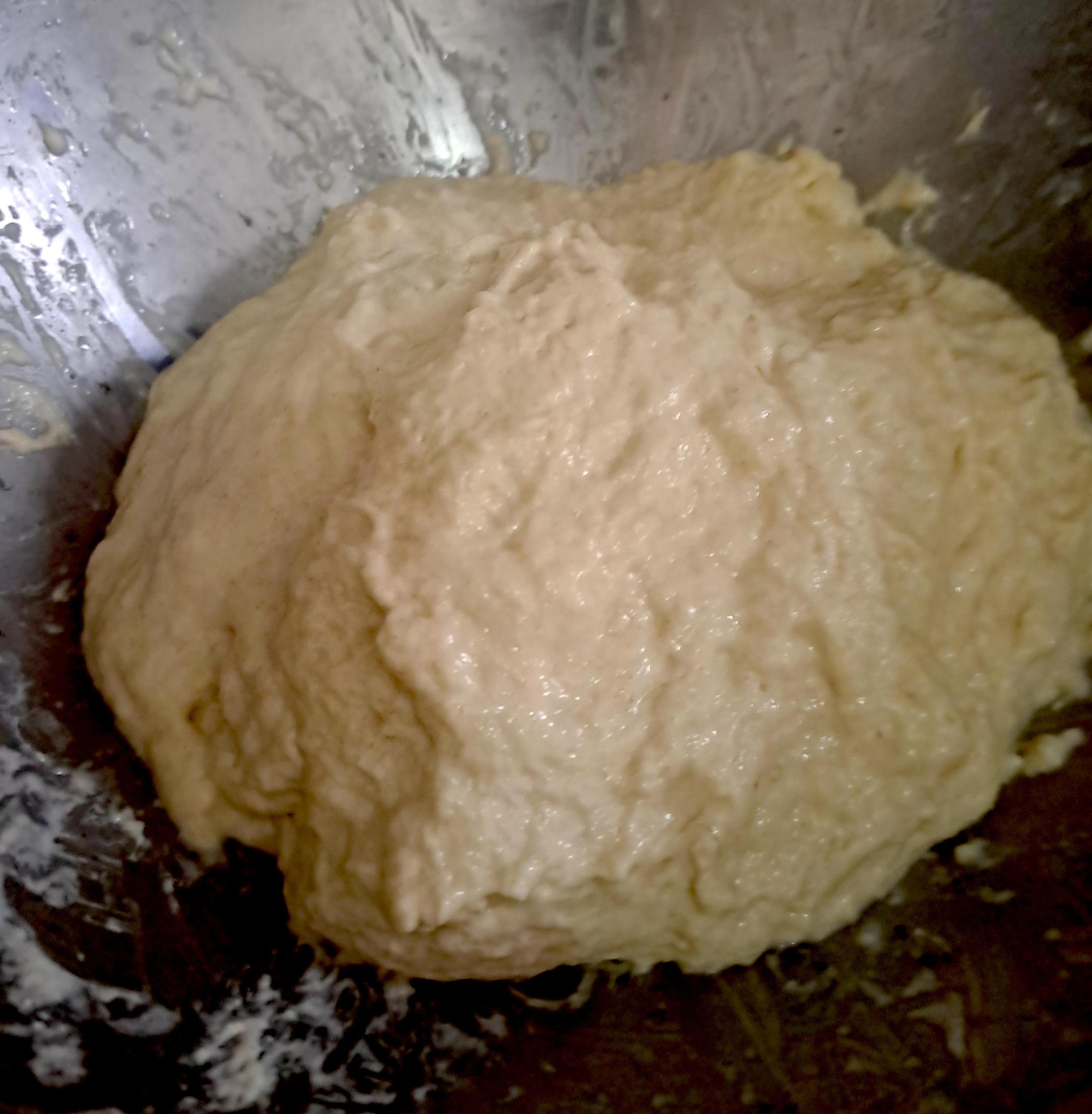
Dough ready for cold fermentation
After 20-hours, the dough in the glass had not risen at all.
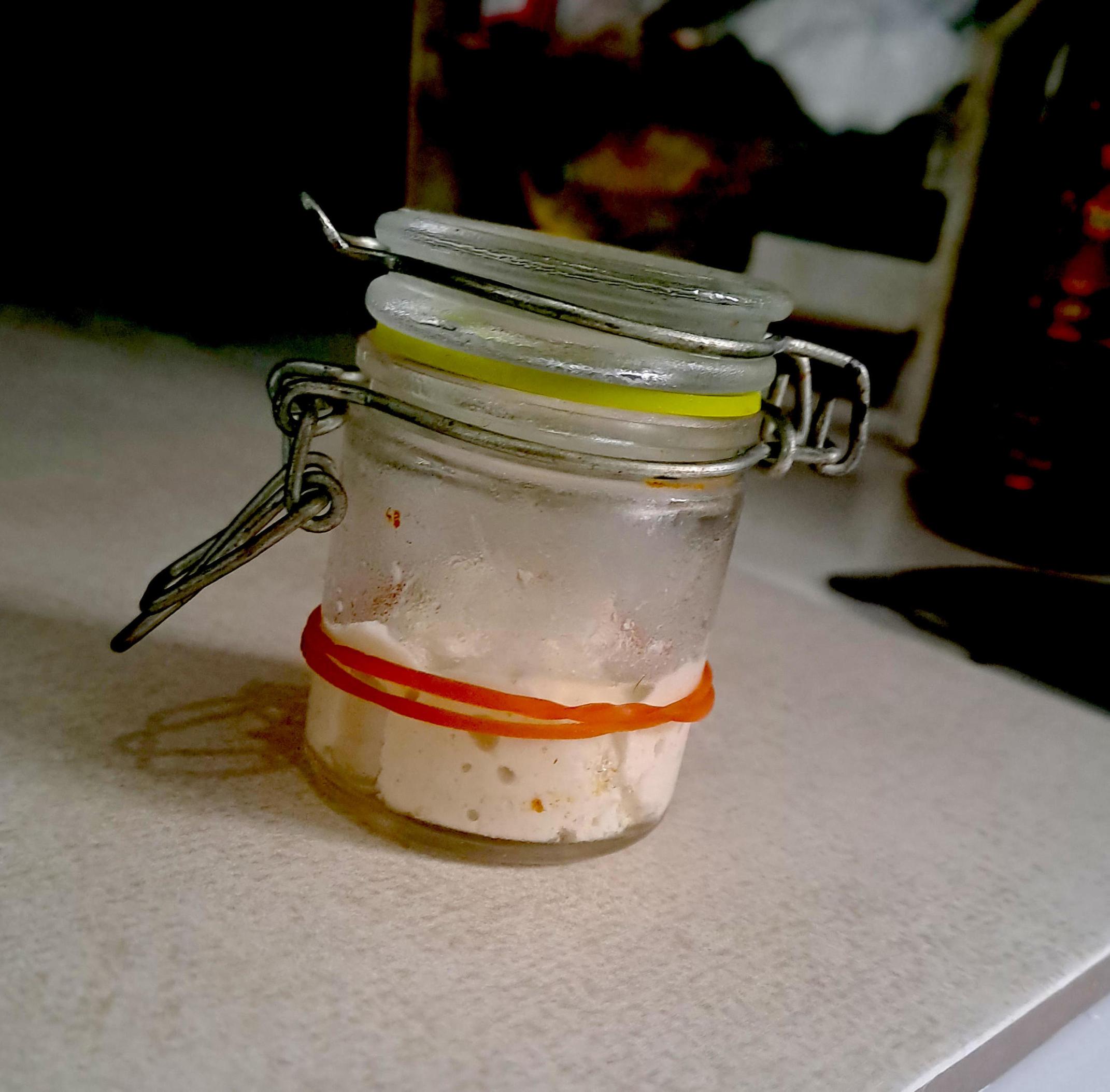
That’s sad
The cold dough in the mixing bowl looked much the same as always, like potato soup.
The dough was similar to my previous attempts: soft but with enough structure for a slow slump but no sign of over-proofing.
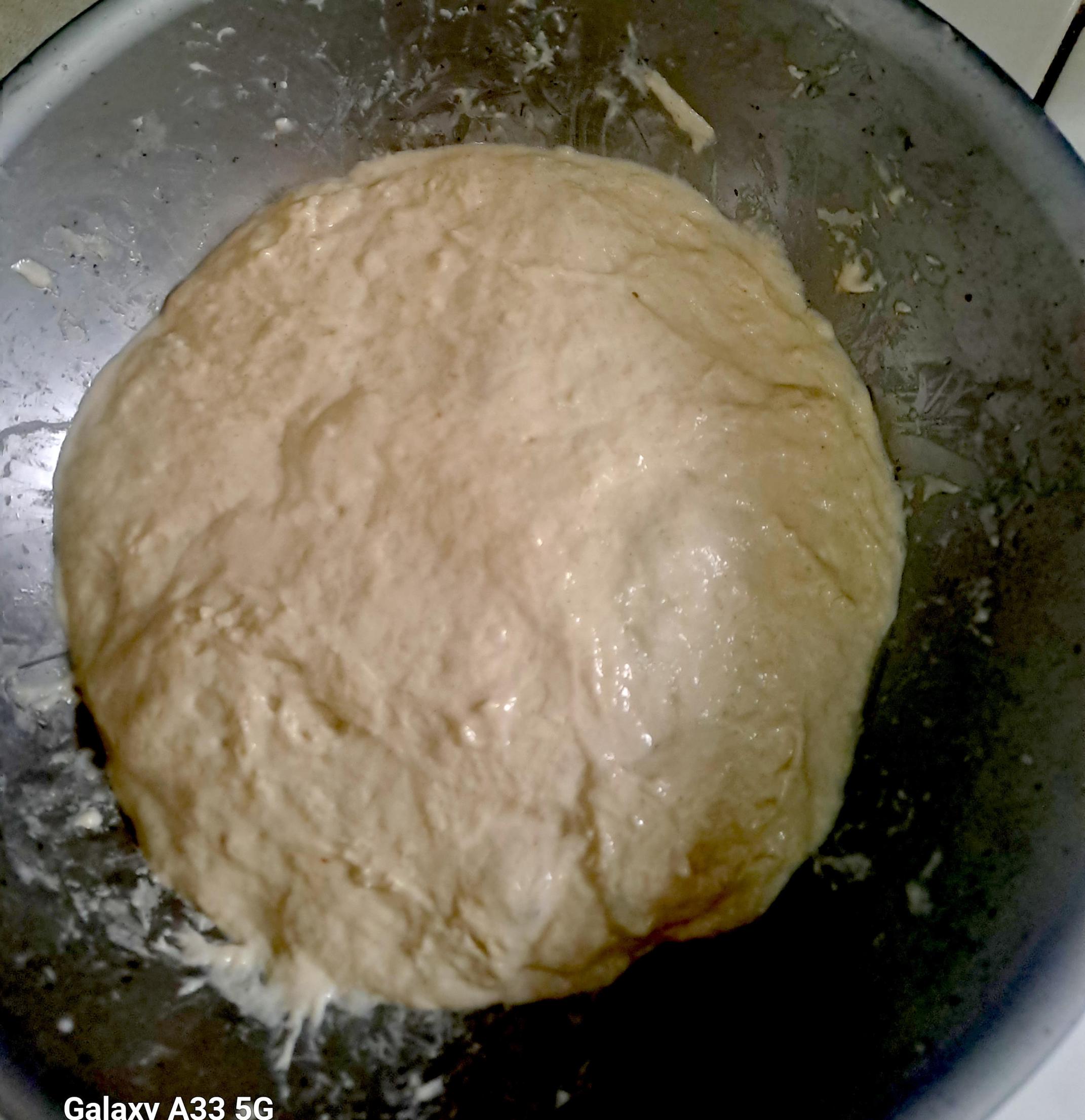
Dough after 20-hours cold fermentation
I turned the dough out onto the peel with little effort, shaped and scored it in a chris-cross as best I could and slipped it into the oven. After removing the cover at the 20-min mark, I could see a definite improvement in oven spring. The finished loaf was a bit lop-sided due to the dough slumping between the peel and the hot cast iron but I was pleased with the overall shape.
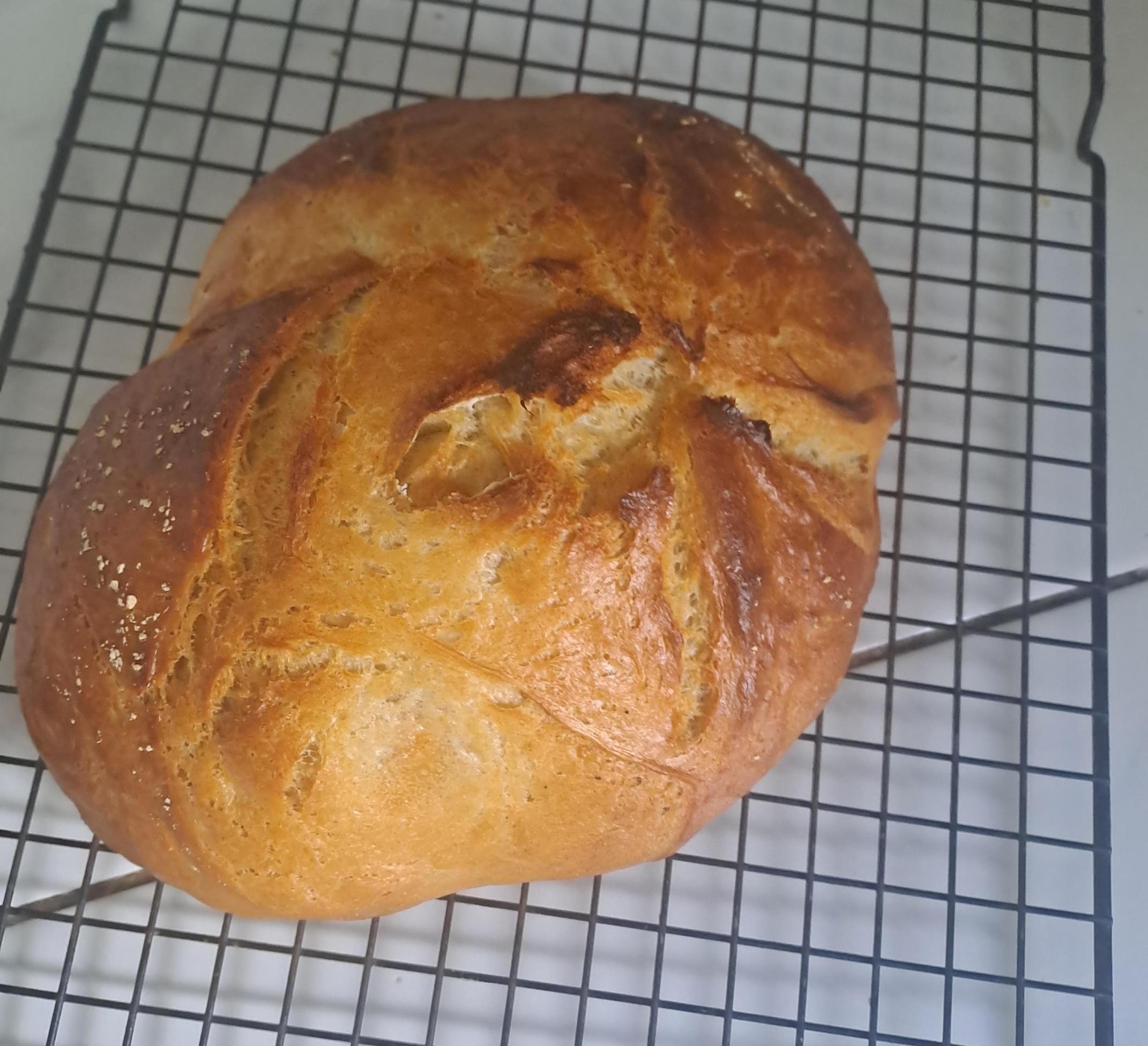
Crust
Unfortunately I lost the open crumb. The crumb is dense and chewy. And the crust harder to cut. My guess is this has much to do with the dough not rising during the cold fermentation.
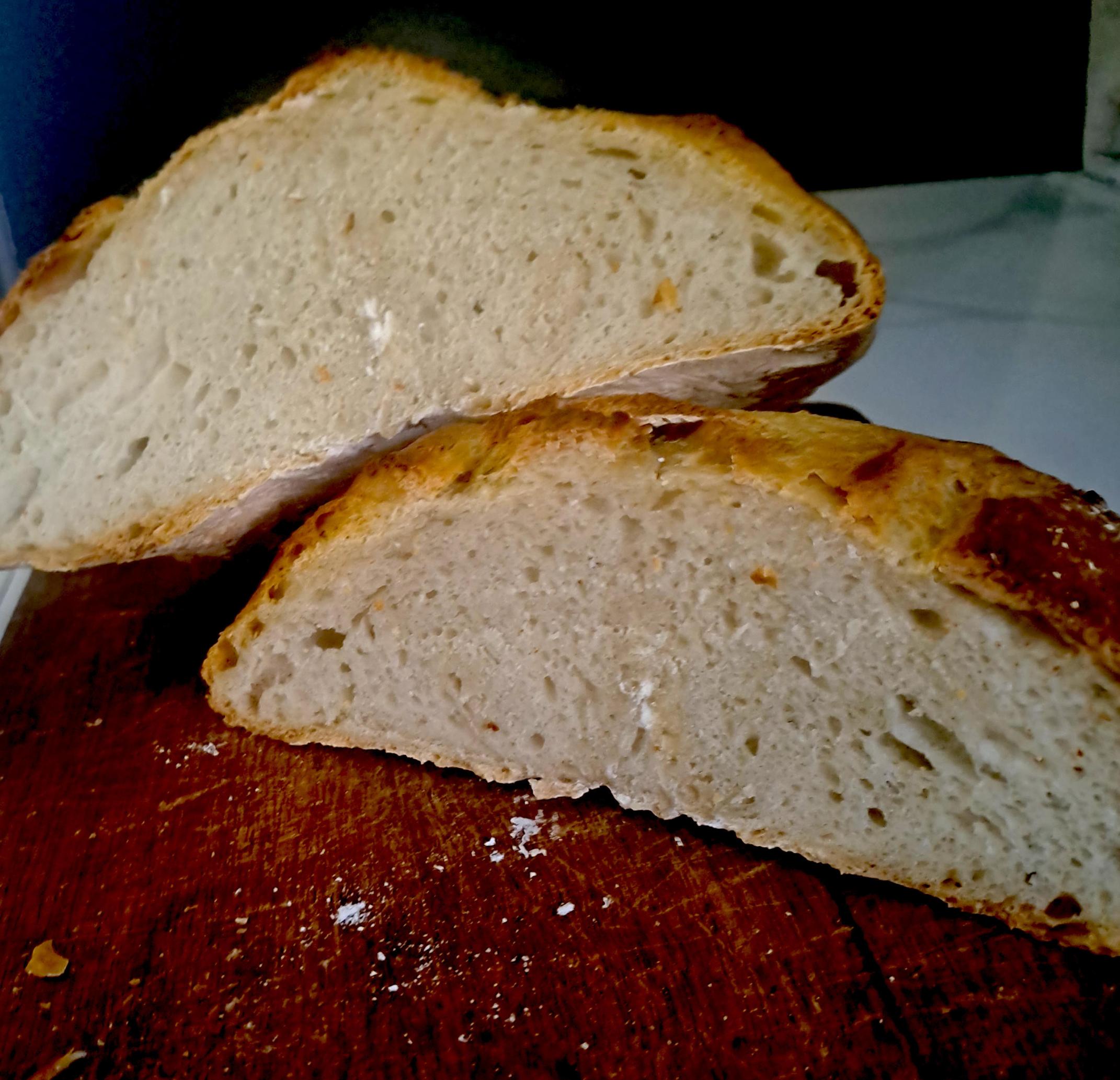
Crumb
Your thoughts, as always, much appreciated.
Katie
That's an interesting experiment, Katie. One thing about refrigerating dough: it usually acts as if it ferments for about an hour after going into the big chill. Then fermentation becomes very slow. Say you wouldn't see visible fermentation after the first hour at room temperature. With only 1/4 tsp yeast I wouldn't expect to see much activity (at room temperature) for several hours at least. So I wouldn't expect to see much activity if the dough went right away into the fridge without waiting
thatthose hours. And that's what you observed.For your flour, the big unanswered question is: if you mixed up a dough without yeast, would it hold up without turning into glop for the number of hours needed to show visible fermentation at room temperature? IOW, is the fermentation itself doing most of the damage, or is it time under hydration separate from fermentation? I don't remember if you have already tried this out.
I too made a biga crumble with weak flour a few days ago and will be posting about it soon. I went to the opposite extreme and put both the biga and the poolish (I put all the flour into those two preferments) in a proofer at 80 deg F for about 6 hours before combining. I refrigerated the shaped loaf overnight before baking. The final freestanding loaf turned out out fairly good. I'm not recommending any particular procedure here. But it does seem that there is plenty of scope for varying the conditions when using a biga crumble.
TomP
Katie, at the end of your last thread you asked if you should use 1/4 tsp of yeast, but did not get an answer. However, in the previous post Rene said, "...with the extra yeast and biga..." you might get a quicker fermentation. It appears he meant 1/2 tsp.
Yes, in the post where he spoke about quantities and method, he advised the larger amount of yeast.
Thanks you two. I figured, as soon as I saw the sample dough had not risen, that I had blown it... too little yeast in the mix. I was a little shy of the over-proofing problem I had, plus I figured 1/4-tsp of yeast should do ‘something’ after 48-hours. Guess not.
And yes, Tom. A long way back I experimented with flour and water at 46%, 53%, 60% hydration. If I remember right, it all was soft and gooey.
I was hoping to get a definitive answer on how much yeast to use this time around but I was ‘hot-to-trot’ and went for it. Anyway the results were encouraging. The dough was hard to work with, but no more difficult than my last couple of loaves using the 24-hour cold fermentation witout biga. If I get an extra lift and openest from the addition of more yeast, then I think I’ll be as close as I can get with this flour.
So... 1/2-tsp of yeast? ...More?
Katie
Here's an idea. Using a biga or poolish, when you combine everything to make the final dough, add another 1/2 or even 1 tsp yeast. You should get the flavor and gluten benefits of the biga while the added yeast will shorten the final fermentation time - which your flour will appreciate.
Katie,
I’ve been experimenting a bit with biga lately, too. I’ve been using my standard levain/poolish practice of breaking up the biga into all of the remaining recipe liquid. I also add any other preferments to the water, mix at low speed for a few minutes to help accelerate biga softening/melting. Then I just cover and let it sit on the counter for 30 or more minutes.
For my baguette recipe, I then add a bit of yeast, mix briefly, cover and rest for 10-15 minutes. Then I add the rest of the flour and salt, mix to shaggy, cover and rest again for 30 +/_. Then it’s knead and bulk ferment. You know the rest…
For my “white brioche” recipe which uses a levain+buttermilk biga-like preferment but no commercial yeast, it’s pretty much the same drill, though I do incorporate the egg whites (@24%!) as part of the liquid component. After that, it’s the same old drill.
The point is, as far as I can tell, the biga and preferment soak helps smooth out the dough mixing and kneading process. Have not had any issues with unincorporated biga or lumpy dough. I suspect that your cold soak may have slowed down the liquefaction(?) of your biga. Just my experience.
Bonne chance,
Phil
Interesting experiment Katie. Good it's got oven spring and kept a descent shape. Shame about the tight crumb. I think you and Tom are right that going directly into the fridge stopped the bulk fermentation in it's tracks. Might help leaving at room temp for a couple of the stretch and folds and then, once it's got going stick it in the fridge.
Some more yeast could be good too, although all my Italian sources are adamant that yeast should be 1% of the biga flour. I will check on an Italian book I have with the biga technique in it and let you know what it says in terms of how the loaf turned out.
The ideal would be to have somewhere that both the biga and bf could ferment at about 20C and then reduce the fermentation times accordingly. At the moment it's as if you can only go with the accelerator or breaks at full and little in between.
I'm convinced you will soon get a good loaf one way or another.
If you need inspiration, just check what Lin has done with a 50% wholegrain rye flour.
Katie used 160g flour in the biga which would be 1.6g yeast which should have been 1/2 tsp.
I'm wondering if you sensed any flavor boost from the biga, Katie.
I'm also wondering what havoc would be created if you didn't refrigerate the biga. I ask this because, in my understanding, the general purpose of a biga is to develop the acids that give bread flavor and not to develop gluten at all. If that's the case -- Rene and others, please correct me if I'm wrong -- you might be able to mix the biga with cold water and leave it at room temp for most of the time it has to rest. Then you can refrigerate the dough once you do the final mix.
On the other hand, if the biga didn't really give more flavor to the bread, why bother?
Rob
To tell you the truth, Rob, I didn’t notice a huge boast in flavor. The bread tasted fine, though. But at this stage, I’m after dough structure and was encouraged by the biga suggestion. I thought prefermenting was all about flavor, not structure. But I’m hoping to be proved wrong here.
The suggestion of letting the biga ferment at room temperature before chilling is intriguing and I’m hoping that someone with more experience than I can get me started with fermentation times and yeast amounts.
Katie
I agree with Rob's thinking. According to the Giorilli book I have (in Italian), an underdeveloped biga will lead to a final dough that is more tough, as if produced by a stronger flour than that used, slightly sticky, will remain more compact during bulk fermentation, and the final loaf will be more heavy and less soft/airy with a crust that will be tougher and with a slightly red hew. So it seems to me that the biga (and the BF?) were likely under fermented and what Rob suggests could be the way to go forward.
Giorilli suggests an ideal temperature for the biga of 18-20C for 24h biga, but writes that a 48h biga can be kept in the fridge (not below 4C) and taken out a few hours before use.
He provides this formula for calculating the water temperature for when mixing the biga:
55 - Ambient Temp(in C) - Flour Temp(in C) = Water Temp (in C)
(I wonder if the Ambient Temp would be constant throughout the biga process in this case?)
Anyway, even with a high ambient temp, using cold water and flour for the biga might be OK even without refrigeration (or possibly with a refrigeration at some point) or, alternatively, a shorter than 24h fermentation for it.
Maybe the same would hold for the bf too, using cold flour and water and then putting it in the fridge only once it is growing well, to slow it down as needed. The calibration jar will show what is needed.
Girolli, in general, is quite fastidious about the right dough/ferment/preferment temperatures.
One last point: the calibration jar dough sample seems to show some descent activity/bubbles in the photo. If the right temperature profile can be found, the fermentation would be good, but does this also indicate that rather than insufficient fermentation that the flour just cant sustain the necessary lift for a good increase in volume? That's my one more general worry with this flour ...
Thanks guys, good information as always... a bit overwhelming actually. (Sounds like Phil is making some nice treats.)
The thing that works for me with this weak flour, and was a bit of a turning point, is keeping everything cold, and cold for as long as possible. As soon as the dough reaches room temperature, certainly by the forth Coil-Fold session, the dough loses structure and is difficult to handle. The downside is “cold” inhibits the yeast. Leaving the dough to bulk ferment for an hour at room temperature seemed to cause over-proofing. To solve the cold dough-rise problem, I’m thinking of:
I know there is no definitive answer, here— it’s pretty much take a shot and see what works. Or more importantly, what doesn’t work. But any suggestions that might reduce the number of experimental loaves is appreciated.
Katie
The observation about cold temperatures is probably one of the more important factors, all right. BTW, I'm not saying that 1/4 tsp is the "right" amount. I'm inclined to go with more so as to reduce all the times involved.
If you can get to the point where you have shaped a loaf and it isn't glopping out, once it has had a chance to start rising then you could refrigerate the loaf and let it finish its proof in the chill, say overnight. Then bake right from the refrigerator, or after it's had some time to warm up but before it's back to full room temperature. There have been several threads here on TFL that discussed baking straight from the fridge. Here's one:
https://weightloss-slim.fit/node/48978/baking-straight-fridge-and-retard-time%3C/a%3E%3C/p%3E%3C/div%3E
If it was me Katie, I would:
I would think of the Girolli text only as general suggestions because Katie's flour is wildly different from any he was working with.
Yes, agree completely.
If a dough loses the structure created - it's done - like toss it. A good dough will hold up throughout the process. Enjoy!
Okay, much thanks. I’m just going to screw with one thing at a time... starting with more yeast.
Katie
One thing at a time is a good way to go. Enjoy!
Here we go again:
This is the exact same recipe as last time except the yeast in the biga was increased to 1/2-tsp and I used a potato masher to incorporate the biga into the additional water after the biga had soaked for 1/2-hour. The potato masher worked great.
My masher
The Bowl-Folds were straight forward as were the Coil-Folds except the dough seemed softer, maybe because the day was a little warmer at 25C.
The dough in the test jar had doubled after 20-hours.
That’s more like it
Out of fridge the dough had risen nicely and there were large bubbles at the surface but even cold, it was too soft to shape and score. I tucked it into a ball but it slumped into an oblong before I could shovel it into the oven. At the 20-min mark I had good oven spring and here’s the result after baking...
Finished loaf
Despite an additional 3-min at 480F, the crust is a little pale and the crumb is better but still pretty dense.
Next we will try letting the biga ferment at room temperature for awhile before chilling. Anyone care to suggest how many hours? So far, I haven’t detected any color nor aroma change in my biga so I have to go by the clock.
Katie
Katie, that's a significant improvement even if it's not the wishes for outcome yet. This is recognisable as a bread loaf! Every iteration is going in the right direction so far. Keep the faith! You are working with a very challenging flour that even expert bakers with professional equipment would struggle with.
I will check my Italian book again, but pale crust probably indicates the biga was too mature now. The test jar shows excellent vigor in the dough so the preferment is working well
If you move to room temp biga, i would not let it go for more than 12h. And do the water and flour temperature calculation when you mix it. I would refrigerate both the four and water before mixing it up into the biga.
You might want to change your last stretch and fold for a letter/lamination type fold to aid your final shaping.
Flour your dough well in the mixing bowl and flour your work surface well too. Tip out your dough onto the flouered surface in whatever shape it has and with your fingertips squash it outwards from the centre as if you are making a pizza base. Go as thin as you are comfortable with making sure the dough is not sticking to the work surface. Sprinkle more flour if necessary under the dough. Once you have a dough disk, fold the two opposite sides towards the centre of the disk, say from the left and right. Then bring the top side of what is now more like a dough strip towards the centre and bring the top to the centre. Take the bottom side and fold it up all the way over the top flap you've folded over towards the centre, till the edge of the bottom side is overlapping with the very end of the top fold. Should now look like a rectangle. Squash down the shape with your fingertips again like before and start to bring all the corners of the shape to meet in the centre. Squash then into each other and ball it up. Don't tighten to much. Put back into the fridge and let it prove getting ready for your final shaping and baking directly from the fridge. This should give it a little more structure, even if quite loose.
Apologies if your are already doing all this. Just trying to find a way to make the final shaping more manageable.
Thanks Rene, that 12-hour suggestion is a real help. Make the biga in the morning...let it sit out all day...refrigerate overnight and I’m set for making the final dough the next day.
But I’m not so sure about the letter/lamination fold. By the time I reach the forth Coil-Fold session, the dough is back to room temperature and is more akin to thick pancake batter than dough. I don’t think I could fold it but maybe turn it over onto itself with a scraper. And pulling the corners into the center will only tear the dough. At any rate, once back in the mixing bowl, the whole thing will just meld together and cow-pie into the bottom of the bowl. So unless the letter/lamination fold magically stiffens the dough immediately, I don’t see a benefit. That’s not to say I won’t try, I will, but this dough is really slack at room-temperature. When I say, even cold, I have to shovel the dough into the oven, I mean shovel it off the peel with a metal spatula.
Anyway, I’ll give it a shot and hope it makes a difference.
Katie
All things considered, I'd lower the hydration a little for these experiments. Otherwise the results are looking better and better.
TomP
Wondering if doing the entire process refrigerated (apart from the biga) might be something to consider? Doing the entire BF and post-shaping proving in the fridge and baking the loaf straight from the fridge?
Never done it and have no idea if it would work, but wondering if it might be something to consider, now that you can judge the rise with the calibration jar.
Also tending towards Tom's suggestion to dial-back a little the hydration. With a vigorous biga fermentation you can get a good open crumb.
My spelt biga loaf is around 60% never more than 65% and it has a very open and satisfying crumb. It would end like yours with any more water than that.
So you’re saying let the dough rest in the fridge for 20-min between all of the folding and coiling sessions and the final letter/lamination fold? Might be something to try. It would affect the fermentation I guess but, as you suggest, with the control sample I would know how to adjust times. Let’s add it to the test list, which is getting longer. Someone else like to help out here and try a few test loaves? Be sure to use pastry flour. Here’s my idea of a perfect open crumb:
Holes are up to the user. Make it holey of you like it - don't make it holey if you don't like it. You can do whatever. Enjoy!
Thank you, Tom. Not sure where I’m headed with all this but I feel I’m baking better bread than ever before but still looking for that elusive airy crumb and crispy crust. Not going to happen :-( ...not with this flour.
I understand what you mean about hydration but because I’m making comparisons with the handling of the biga, I need to keep the hydration consistent for the time being. More tweaking to come...
Katie
I forgot - it's not your flour. Enjoy!
So for this effort we are fermenting the biga at room temperature for 12-hours before placing it into the fridge for an additional 12-hours.
The biga was more coherent coming out of the cold, and stiffer, but blended more easily with the additional cold salt/water mix to form the dough. And mixing in the remaining flour resulted in what I’ve come to expect: a rather stiff, sticky ball.
Bowl-Folds and Coil-Folds were similar to previous attempts, the folds becoming more difficult as the dough reached room temperature. I was reminded of Rene’s suggestion of keeping everything refrigerated while doing the folds, but wet fingers helped me accomplish the task at hand.
When ready for the 24-hour cold fermentation, the dough looked like porridge in the bottom of the bowl. Nothing new.
Surprisingly, the dough struggled to rise. After a full 24-hours, my sample had not quite doubled in volume; not like last time when fermentation was vigorous and much quicker.
Not quite there after 24-hours
The dough was too soft to score successfully but after a couple of Tuck-Under Rolls I managed to get the cold dough onto the skillet without losing all of its shape. It came out of the oven looking more like a ciabatta than a boule, but I got reasonable oven spring and the loaf looked larger than before.
The resulting loaf was the best so far
The crust was slightly crispy, an improvement over the chewy, leather-like crust on previous loaves. The the crumb was light with a proliferation of small air pockets. I’ve never come this close to an airy crumb. Very exciting. Much thanks to everyone who got me to this stage.
Coming up, we try splitting the 1/2-tsp of yeast equally between the biga and the final dough.
Writing with my mouth full... Katie
Fantastic achievement! When you get that airy loaf you so desire (when, not if), you will truly be the OpenCrumbGuru™. And how great it is that you get to eat your experiments along the way.
Rob
PS: how's Bolo doing?
Thanks Rob, and yeah, this was a major step forward. The most important development so far. What a treat!
Bolo has developed a sore tooth. There is some swelling but it doesn’t seem to bother him much. No matter, he has an appointment with the vet. That will give him something to think about!
Katie
Yay! Does it taste good?
Hey Moe... It tastes good but I have to admit that I’ve had a lot better. And I’m still not getting that wonderful fragrance of baking bread from my oven. At some point I may play around with increasing the baking time but not sure whether to increase the “covered” or the “uncovered” time, or adjust both. There’s just too many variables.
Katie
A half-teaspoon of yeast isn't going to give you much of a bakery smell.
not sure this is entirely true: https://modernistcuisine.com/mc/why-does-baking-bread-smell-so-good/. The chemists on this site will know more than me, but I suspect that even a tiny amount of yeast, over time, will convert starches to the sugars and amino acids that give bread its great smell in the oven. -- Rob